

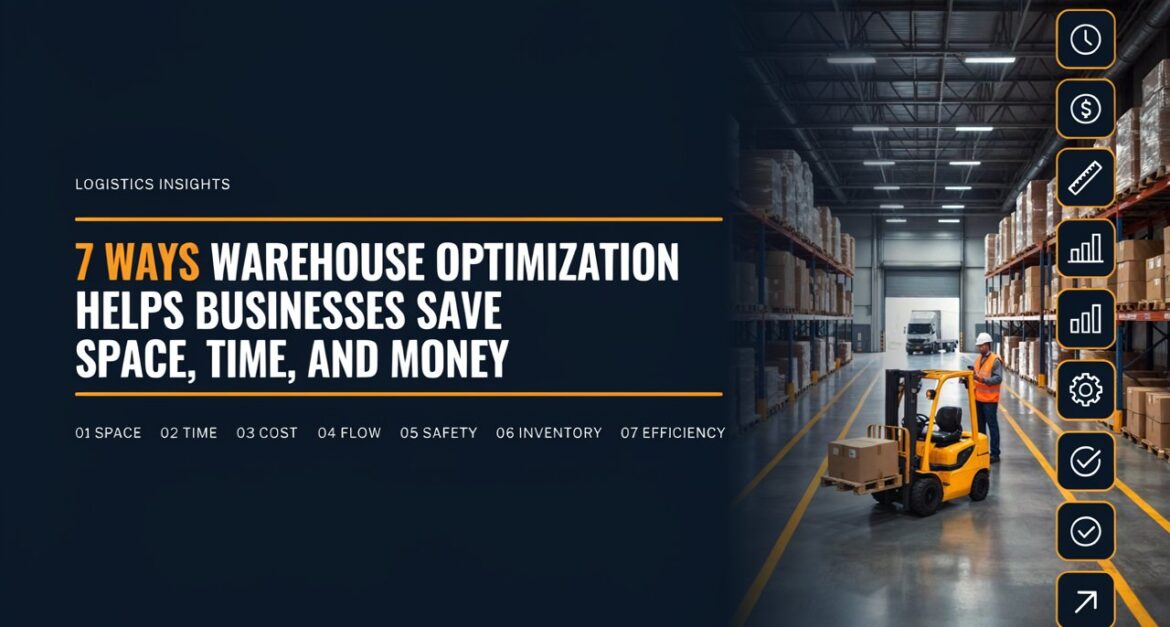
Introduction: The Hidden Cost of an Inefficient Warehouse
Walk into almost any growing business’s warehouse in Saudi Arabia today, and you’ll likely see the same story playing out: pallets stacked in the wrong zones, pickers walking the length of the facility for a single order, and inventory counts that never quite match what’s on the shelf. It’s not a failure of effort — it’s a failure of design.
As e-commerce, retail, and industrial supply chains across the Kingdom scale faster than ever, warehouses that once worked fine start to buckle under pressure. Orders take longer to fulfill. Storage costs climb. Errors creep into inventory records. And leadership starts asking a simple but uncomfortable question: why does it feel like we’re working harder but shipping less?
This is exactly the problem warehouse optimization solves — and it’s why companies like Palm Horizon KSA have built their practice around helping businesses turn chaotic storage facilities into lean, high-throughput operations.
This guide breaks down what warehouse optimization actually means, how to approach it practically, and the seven measurable ways it improves business performance — with real-world context for teams operating in fast-growing markets like Saudi Arabia.
What Is Warehouse Optimization?
Warehouse optimization is the process of improving how a warehouse uses its space, labor, technology, and workflows to move inventory more efficiently — from the moment goods arrive to the moment they leave for delivery.
At its core, it answers one question: how do we get the most output from the same square footage, the same team, and the same inventory?
Businesses pursue warehouse optimization because unoptimized operations quietly bleed money in ways that don’t always show up on a balance sheet immediately — wasted walking time, underused vertical space, mispicked orders, and idle equipment all add up.
Done well, optimization improves:
- Productivity — fewer wasted movements, more orders per labor hour
- Storage efficiency — better use of existing square meters, less need to lease more space
- Inventory movement — faster, more predictable flow from receiving to shipping
- Cost control — lower labor, storage, and handling expenses per order
And because a warehouse rarely operates in isolation, optimization has a ripple effect across the entire supply chain — faster warehouse cycles mean faster delivery promises, better supplier coordination, and more resilient inventory planning during demand spikes (a particularly relevant concern during peak retail seasons in the GCC region).
How to Optimize a Warehouse
Warehouse optimization isn’t a single fix — it’s a structured process. Here’s the practical sequence most successful operations follow:
- Analyze current warehouse performance. Before changing anything, measure it. Look at order cycle times, storage utilization rates, and labor productivity.
- Identify bottlenecks and wasted space. Common culprits: congested receiving docks, underused vertical racking, and dead zones where slow-moving stock sits.
- Review inventory movement. Map how products actually travel through the facility — not how the layout was originally designed.
- Improve storage locations. Fast-moving SKUs should sit closest to picking and packing areas; slow movers can go further back or higher up.
- Optimize picking routes. Redesign paths so pickers cover less distance per order — even small route changes compound into major time savings.
- Use warehouse technology. Barcode scanning, WMS software, and automation reduce manual error and speed up nearly every step.
- Track performance continuously. Optimization isn’t a one-time project — it requires ongoing KPI monitoring to stay effective as order volume and product mix change.
How to Optimize Warehouse Operations
While warehouse-wide optimization looks at the big picture, optimizing warehouse operations focuses on the day-to-day mechanics that determine whether a facility runs smoothly or constantly firefights problems.
Receiving Processes
Fast, accurate receiving sets the tone for everything downstream. Standardized check-in procedures and barcode verification at intake prevent errors before they multiply.
Put-Away Strategies
Where inventory lands immediately after receiving determines how easy it is to find later. Smart put-away rules — based on velocity, size, and demand — cut future picking time significantly.
Picking Efficiency
Picking is typically the most labor-intensive warehouse task. Batch picking, zone picking, and optimized routing can reduce picker travel time dramatically.
Packing Workflows
Standardizing packing stations with the right materials on hand reduces packing time and shipping errors.
Inventory Accuracy
Cycle counting and real-time inventory tracking (rather than relying on annual audits) keep stock records reliable.
Labor Management
Cross-training staff and aligning shift schedules with actual order volume peaks prevents both understaffing and idle labor cost.
Equipment Utilization
Forklifts, conveyors, and scanners sitting idle — or overused on one line while underused on another — signal a scheduling and layout problem worth solving.
Performance Monitoring
Daily and weekly KPI dashboards (orders per hour, pick accuracy, dock-to-stock time) catch small inefficiencies before they become expensive habits.
7 Ways Warehouse Optimization Improves Business Performance
1. Reduces Wasted Warehouse Space
Better organization — through smarter racking, slotting, and layout — helps businesses use existing storage capacity more effectively, often delaying or eliminating the need to lease additional square footage.
2. Improves Picking Speed
Optimized workflows and strategic product placement reduce unnecessary travel time, which is often the single largest time cost in warehouse labor.
3. Lowers Operating Costs
Efficient processes reduce labor hours, storage overhead, and handling costs — savings that compound month over month.
4. Improves Inventory Accuracy
Better systems and structured workflows reduce human error, meaning fewer stockouts, fewer overstocks, and fewer costly reconciliation headaches.
5. Increases Order Processing Speed
When receiving, storage, picking, and packing are all aligned, orders move through the facility faster — directly improving customer delivery promises.
6. Improves Employee Productivity
Clear, logical workflows reduce unnecessary manual work and confusion, letting staff focus on throughput instead of navigating a disorganized facility.
7. Supports Business Growth
A well-optimized warehouse can absorb increasing order volume without a proportional increase in headcount or space — a critical advantage for scaling businesses.
Fun fact: Studies on warehouse ergonomics have found that a single picker can walk the equivalent of a marathon (over 40 km) per week in a poorly designed warehouse. Smart slotting and route optimization can cut that distance by nearly a third — turning wasted footsteps into fulfilled orders.
What Is Warehouse Layout Optimization?
Warehouse layout optimization is the strategic arrangement of a facility’s physical zones — storage areas, receiving docks, picking locations, packing stations, shipping areas, and equipment pathways — to minimize travel distance and maximize flow.
Layout decisions should be driven by product movement and order frequency, not convenience or historical habit. For example:
- High-frequency SKUs belong near packing and shipping zones.
- Bulky, slow-moving inventory can sit further from active picking areas.
- Equipment pathways (forklifts, pallet jacks) need dedicated lanes separate from foot traffic to avoid bottlenecks and safety risks.
A well-designed layout isn’t static — it should evolve as product mix and order patterns shift, particularly for businesses experiencing seasonal demand swings.
How Warehouse Space Optimization Creates More Storage Capacity
Warehouse space optimization focuses specifically on maximizing usable storage without expanding the physical footprint. Key strategies include:
- Vertical storage — using height, not just floor area, through taller racking systems
- Better racking systems — selective, drive-in, or push-back racking suited to inventory type
- Slotting optimization — placing items based on velocity and size, not arbitrary order
- Removing obsolete inventory — dead stock quietly consumes prime storage real estate
- Improving aisle design — narrower, well-planned aisles can add meaningful storage without sacrificing accessibility
- Using flexible storage locations — adaptable shelving for seasonal or fluctuating inventory
- Reviewing storage utilization — regular audits reveal where capacity is being wasted
Fun fact: Many warehouses only use 60–70% of their available vertical space. Simply raising racking height and adjusting for proper vertical slotting can unlock significant extra capacity without adding a single square meter of floor space.
What Is Warehouse Optimization Software?
Warehouse optimization software is technology designed to support and automate the decision-making behind efficient warehouse operations. It typically supports:
- Inventory tracking in real time
- Warehouse slotting recommendations
- Picking route optimization
- Labor planning and scheduling
- Space utilization analysis
- Order prioritization logic
- Performance analytics and reporting
Most modern platforms also integrate with Warehouse Management Systems (WMS), ERP systems, inventory management tools, and transportation platforms — creating a connected data flow from supplier to customer doorstep. This integration is increasingly important for businesses in Saudi Arabia managing multi-channel fulfillment across retail, wholesale, and e-commerce simultaneously.
When Does a Business Need Warehouse Optimization Consulting?
Not every business needs to solve warehouse inefficiency alone — and that’s where warehouse optimization consulting becomes valuable. Companies typically seek expert support when they:
- Experience frequent fulfillment delays
- Have unusually high warehouse operating costs relative to output
- Struggle with limited or poorly utilized space
- Experience recurring picking errors
- Need to redesign a warehouse from the ground up
- Are expanding operations or entering new markets
- Need an independent, objective process analysis
This is precisely where a specialized partner like Palm Horizon KSA adds value — bringing outside expertise, data-driven analysis, and hands-on implementation support that internal teams often don’t have the bandwidth (or specialized tools) to execute alone.
How Palm Horizon KSA’s Approach Compares
| Factor | In-House DIY Optimization | Generic Software-Only Tools | Palm Horizon KSA Consulting |
| Local market knowledge (KSA logistics, regulations, labor patterns) | Limited | None | Built-in |
| Objective, data-driven diagnosis | Often biased by internal habits | Data without context | Data + contextual analysis |
| Implementation support | Time-consuming, trial-and-error | Software only, no execution help | End-to-end guidance |
| Speed to measurable results | Slow | Moderate | Faster, prioritized roadmap |
The takeaway isn’t that software or internal effort is wrong — it’s that combining local expertise with the right technology and a structured process consistently produces faster, more reliable results than either approach alone.
Warehouse Optimization Challenges Businesses Should Address
Even well-intentioned optimization efforts stall when these common problems go unaddressed:
- Poor warehouse layout inherited from earlier, smaller operations
- Underused vertical space
- Inefficient or undocumented picking routes
- Excess or obsolete inventory taking up prime space
- Poor inventory visibility across systems
- Manual, paper-based processes prone to error
- Bottlenecks at receiving and shipping docks during peak periods
Recognizing these issues early — ideally through a structured audit — prevents small inefficiencies from compounding into systemic operational problems.
Technology That Supports Warehouse Optimization
Modern warehouse optimization increasingly relies on a stack of complementary technologies:
- Warehouse Management Systems (WMS) — the operational backbone for inventory and workflow control
- Barcode scanning — fast, low-error data capture
- RFID — real-time tracking without manual scanning
- Automation — conveyor systems, automated storage/retrieval systems (AS/RS)
- Robotics — increasingly common for repetitive picking and transport tasks
- AI-powered analytics — predictive demand planning and dynamic slotting
- IoT sensors — real-time environmental and equipment monitoring
- Inventory optimization tools — demand forecasting and reorder automation
Fun fact: Some of the world’s largest fulfillment centers use robotics fleets that can reduce order picking time by more than 50% compared to fully manual operations — a gap that’s narrowing quickly as automation becomes more accessible to mid-sized businesses too.
How to Build a Long-Term Warehouse Optimization Strategy
Sustainable results come from treating optimization as an ongoing discipline, not a one-time project:
- Measure current performance — establish a clear baseline.
- Define optimization goals — be specific: reduce pick time by X%, cut storage costs by Y%.
- Identify operational bottlenecks — prioritize based on impact, not visibility.
- Prioritize high-impact improvements — tackle the changes with the best ROI first.
- Improve warehouse layout and space usage — implement layout and slotting changes.
- Introduce suitable technology — match tools to actual operational needs, not trends.
- Train warehouse teams — technology and layout mean little without adoption.
- Monitor KPIs — track pick rate, accuracy, cost per order, and space utilization continuously.
- Continuously improve processes — revisit the strategy as order volume and product mix evolve.
Frequently Asked Questions
1. What is the main goal of warehouse optimization?
The main goal is to improve how efficiently a warehouse uses its space, labor, and technology to move inventory faster and at lower cost — without necessarily expanding the physical facility.
2. How long does it take to see results from warehouse optimization?
Many businesses see measurable improvements in picking speed and space utilization within a few weeks of implementing layout and slotting changes, while deeper technology integrations may take a few months to fully pay off.
3. Is warehouse optimization only useful for large warehouses?
No — small and mid-sized warehouses often see proportionally larger gains, since inefficiencies (like poor layout or manual tracking) tend to have an outsized impact relative to their smaller scale.
4. What’s the difference between warehouse optimization and warehouse automation?
Optimization is the broader strategy of improving processes, layout, and efficiency — automation is one tool (among several) that can support that strategy, particularly for repetitive, high-volume tasks.
5. Do I need warehouse management software to optimize my warehouse?
Not necessarily at first — many foundational improvements (layout, slotting, picking routes) can be made without software. However, software becomes increasingly valuable as inventory complexity and order volume grow.
6. How does warehouse optimization affect delivery times?
Faster, more accurate picking and packing directly reduce the time between order placement and shipment — which is often the biggest lever businesses have over overall delivery speed.
7. Should a growing business optimize before or after expanding warehouse space?
Optimizing first is usually more cost-effective — many businesses discover they can absorb significant growth in their existing space once inefficiencies are addressed, delaying or reducing the need for costly expansion.
Conclusion: Turning Your Warehouse Into a Competitive Advantage
An unoptimized warehouse doesn’t just cost money quietly in the background — it caps how fast a business can grow, how reliably it can deliver, and how competitive it can stay in an increasingly fast-moving market. The good news is that warehouse optimization isn’t about starting over. It’s about methodically identifying what’s not working, fixing it in the right order, and building systems that keep improving over time.
Whether you’re dealing with cramped storage, slow picking, inventory errors, or simply preparing for the next stage of growth, the right optimization strategy can transform your warehouse from a operational bottleneck into one of your business’s strongest advantages.
Palm Horizon KSA specializes in exactly this — helping businesses across Saudi Arabia diagnose inefficiencies, redesign layouts, implement the right technology, and build long-term optimization strategies tailored to local market realities. If your warehouse feels like it’s working against you instead of for you, the first step is a clear-eyed assessment of where the biggest opportunities are hiding — and that’s exactly where a focused optimization partner makes the difference.