

Every day, goods move through warehouses, onto trucks, and across borders — and every one of those steps either adds friction or removes it. For businesses trying to scale their supply chain in Saudi Arabia and the wider GCC, the difference between a smooth operation and a costly one usually comes down to one thing: whether you’re actually measuring what matters.
Many warehouse managers still run operations on instinct — “shipments feel late this month” or “the warehouse seems slower than usual.” The problem is that feelings don’t fix bottlenecks. Numbers do. That’s where logistics KPI tracking comes in, and it’s exactly what separates growing logistics brands like Palm Horizon KSA from operations that are constantly firefighting instead of improving.
This guide breaks down what KPIs mean in logistics, the seven most important ones to track, how to choose the right ones for your business, and the mistakes most companies make when they try.
Fun fact: According to supply chain research bodies, a 1% improvement in on-time delivery performance can reduce customer churn by measurable margins in e-commerce — which is why even “small” KPI gains often translate into real revenue.
What Does KPI Mean in Logistics?
KPI stands for Key Performance Indicator — a measurable value that shows how effectively a business is achieving specific operational goals.
In the context of what does kpi mean in logistics, a KPI isn’t just a number on a dashboard. It’s a signal. It tells you:
- How efficiently goods are moving through your supply chain
- Whether your warehouse team is meeting productivity expectations
- How much it costs to fulfill and ship each order
- Where delays, errors, or waste are happening before they become customer complaints
Businesses use logistics KPIs because guessing doesn’t scale. As order volumes grow, so does complexity — more SKUs, more carriers, more warehouse zones, more moving parts. KPIs give operations teams a shared language to track performance, spot problems early, and make decisions based on evidence rather than assumption.
In short: KPIs turn logistics from a reactive function into a proactive, data-driven discipline.
What Is a KPI in Logistics?
A KPI in logistics is a specific metric tied to a core operational function — used to measure how well that function is performing against a target or benchmark.
Logistics KPIs typically fall into a few key categories:
- Delivery performance — Are shipments arriving on time and intact?
- Warehouse productivity — How efficiently is labor and space being used?
- Shipping costs — What does it actually cost to move a unit from warehouse to customer?
- Order accuracy — Are customers receiving exactly what they ordered?
- Inventory movement — How fast is stock turning over, and how accurate are the records?
- Transportation efficiency — Are carriers and routes optimized, or is money being lost in transit?
Rather than tracking dozens of disconnected numbers, the goal is to focus on the KPIs that are most prominent in your operation, most popular (industry-standard, so you can benchmark), and most relevant to your specific business goals — a simple filter that keeps KPI dashboards useful instead of overwhelming.
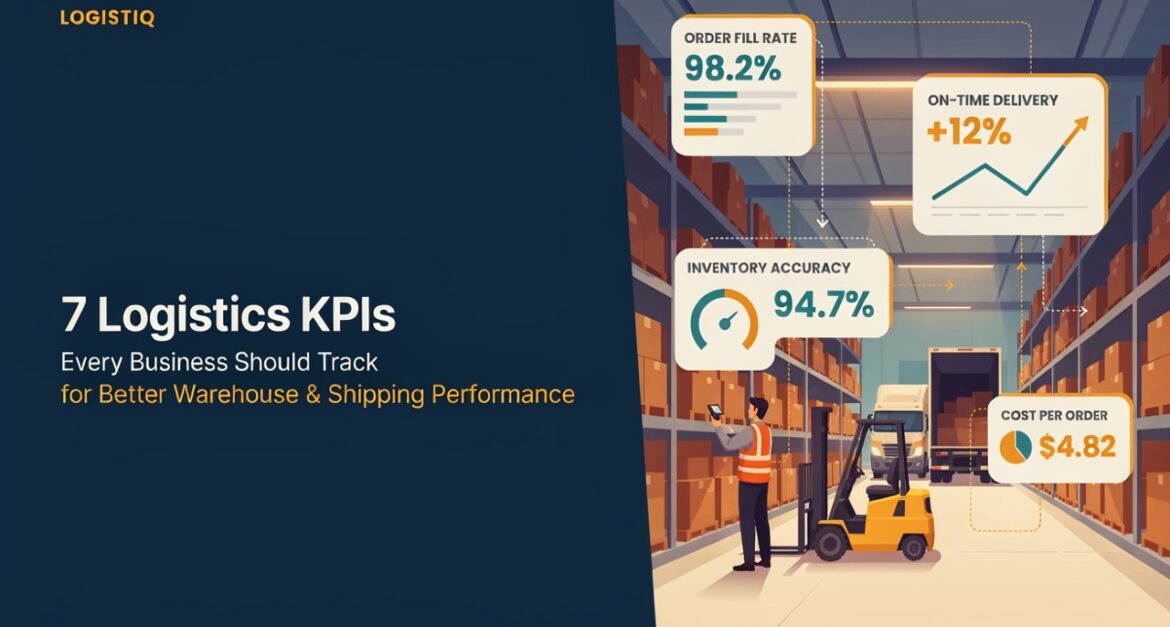
7 Logistics KPIs Every Business Should Track
These seven form the backbone of any serious logistics KPI framework — whether you’re running a single warehouse or a multi-city distribution network.
1. On-Time Delivery Rate
Measures how consistently shipments reach customers within the promised delivery window. This is often the single most customer-visible KPI — and one of the fastest ways to lose or win trust.
Formula: (On-Time Deliveries ÷ Total Deliveries) × 100
2. Order Accuracy Rate
Tracks whether customers receive the correct products, in the correct quantities, without substitutions or missing items. Low order accuracy quietly drives up return rates and support tickets.
3. Cost per Shipment
Helps businesses monitor transportation and shipping expenses per order — factoring in fuel, labor, packaging, and carrier fees. This KPI is essential for pricing decisions and margin protection.
4. Order Cycle Time
Measures the total time from order placement to order fulfillment. Shorter cycle times generally mean happier customers and lower holding costs.
5. Inventory Accuracy
Shows how closely your recorded inventory matches what’s physically on the shelf. Poor inventory accuracy leads to stockouts, overselling, and emergency restocking costs.
6. Warehouse Picking Accuracy
Measures how correctly warehouse staff pick items for outgoing orders — a direct driver of order accuracy and customer satisfaction downstream.
7. Transportation Cost as a Percentage of Sales
Helps businesses understand how much of their revenue is being consumed by transportation — a critical KPI for long-term profitability planning.
Here’s how these benchmarks typically compare across a mid-sized logistics operation:Most well-run operations aim for the 90–99% range across these five KPIs — anything consistently below that signals a process gap worth investigating.
Fun fact: Some global retailers have found that improving order accuracy by just 2–3% can reduce return-related logistics costs by double digits, since a single wrong item often triggers a full reverse-logistics cycle — pickup, inspection, restocking, and re-shipping.
What Are the Most Important KPIs for Warehouse and Logistics?
When narrowing focus specifically to warehouse operations, the most important KPI for warehouse and logistics performance include:
- Inventory accuracy — the foundation of reliable fulfillment
- Picking accuracy — directly tied to order accuracy and returns
- Order processing time — how fast an order moves from “received” to “packed”
- Warehouse capacity utilization — whether storage space is being used efficiently or wasted
- Dock-to-stock time — how quickly incoming inventory is checked in and shelved
- Labor productivity — units processed per worker-hour
- Order fulfillment accuracy — the end-to-end accuracy of the entire fulfillment chain
Warehouses that track these consistently tend to catch problems — like a bottleneck at receiving or a mis-slotted SKU zone — long before they show up as customer complaints.
What Are the Best KPIs for Shipping and Logistics?
On the transportation side, the most valuable KPI for shipping and logistics metrics focus on what happens after the product leaves the warehouse:
- On-time delivery rate — the customer-facing measure of reliability
- Cost per shipment — the financial measure of efficiency
- Transit time — how long shipments actually spend in transit versus planned time
- Freight damage rate — how often goods arrive damaged
- Carrier performance — comparing reliability and cost across shipping partners
- Shipment tracking accuracy — whether tracking data matches real shipment status
- Delivery exception rate — how often deliveries fail, are delayed, or are rerouted
Businesses that operate across the GCC region — including operators like Palm Horizon KSA — often find that carrier performance and transit time variability are the two metrics most worth watching closely, since regional infrastructure and customs processes can introduce inconsistency that a single national carrier report won’t reveal.
How to Choose the Right Logistics KPI for Your Business
Not every business needs to track all fourteen-plus metrics mentioned above. The right approach is to choose KPIs based on:
- Business goals — Are you optimizing for cost, speed, or accuracy right now?
- Customer expectations — What do your customers actually complain about or praise?
- Warehouse operations — Where are your internal bottlenecks?
- Transportation costs — Is shipping eating into your margins?
- Delivery performance — Is on-time delivery already strong, or inconsistent?
- Available data — Can you actually measure this reliably today?
- Areas with frequent problems — Where do issues keep recurring?
A useful rule: track 5–7 KPIs deeply rather than 20 KPIs shallowly. Depth beats breadth when it comes to actionable data.
How to Improve Logistics KPI Performance
Improving performance is rarely about a single fix — it’s a repeatable cycle:
- Establish clear performance targets for each KPI, based on industry benchmarks and business goals.
- Collect accurate operational data from WMS, TMS, and carrier systems.
- Use centralized dashboards so warehouse, transportation, and customer service teams see the same numbers.
- Monitor KPIs regularly — weekly for operational metrics, monthly for cost-based ones.
- Identify the root causes of poor performance rather than treating symptoms.
- Improve processes and workflows based on what the data actually shows.
- Review results continuously, adjusting targets as the business scales.
Why Tracking Logistics KPIs Matters
Consistent KPI tracking helps businesses:
- Identify operational bottlenecks before they escalate
- Reduce unnecessary costs across warehousing and transportation
- Improve warehouse productivity through targeted process changes
- Improve shipping performance and carrier accountability
- Make data-driven decisions instead of reactive ones
- Improve customer satisfaction through consistent, reliable service
For a growing logistics brand, this is the difference between scaling profitably and scaling into chaos.
Common Mistakes When Tracking KPIs in Logistics
Even experienced operations teams fall into these traps:
- Tracking too many metrics — leading to dashboard fatigue and no clear priorities
- Using inaccurate data — which makes every KPI unreliable, no matter how well-tracked
- Measuring KPIs without clear goals — numbers with no benchmark to compare against
- Ignoring warehouse-specific metrics — focusing only on delivery while warehouse inefficiencies go unnoticed
- Failing to review KPI trends — looking at snapshots instead of patterns over time
- Not taking action based on results — collecting data but never changing a process because of it
Avoiding these mistakes is often more valuable than adding new KPIs — a smaller, well-maintained dashboard beats a large, ignored one every time.
Frequently Asked Questions
What does KPI mean in logistics operations?
KPI stands for Key Performance Indicator — a measurable metric used to track how well a specific logistics function, such as delivery, warehousing, or shipping, is performing against a target.
What is the most important logistics KPI to start with?
Most businesses start with on-time delivery rate and order accuracy, since these two metrics have the most direct impact on customer satisfaction and retention.
How often should logistics KPIs be reviewed?
Operational KPIs like picking accuracy and order cycle time are best reviewed weekly, while cost-based KPIs like transportation cost as a percentage of sales are usually reviewed monthly or quarterly.
Can small businesses use the same KPIs as large logistics companies?
Yes — the KPIs themselves scale. A small business may track them manually or with simple spreadsheets, while larger operations use dedicated WMS and TMS dashboards, but the core metrics remain relevant either way.
What’s the difference between a warehouse KPI and a shipping KPI?
Warehouse KPIs measure what happens inside the facility — picking, storage, and inventory accuracy — while shipping KPIs measure what happens after the product leaves, such as transit time and delivery performance.
How many KPIs should a logistics business track at once?
Most experts recommend focusing on 5–7 core KPIs at a time to avoid data overload, expanding the list only once those are consistently well-managed.
Final Thoughts
Logistics success rarely comes down to luck — it comes down to visibility. Businesses that track the right KPIs, from on-time delivery rate to warehouse picking accuracy, consistently outperform those relying on gut feeling. The seven KPIs outlined here aren’t just numbers to report; they’re the early-warning system that keeps warehouses efficient, shipping costs under control, and customers satisfied.
Whether you’re managing a single warehouse or a multi-region distribution network like the one behind Palm Horizon KSA, the principle is the same: what gets measured, gets managed — and what gets managed, gets better.