
Introduction
A vial of vaccine, a pen of insulin, or a bag of blood plasma looks simple on a shelf. But the moment it leaves the manufacturer, it starts a journey where a few degrees can change everything.
Many medicines only stay safe and effective inside a narrow temperature window. If a shipment sits on a hot tarmac, waits too long in customs, or loses power in a truck, the product may become unusable. In the worst case, a compromised medicine can reach a patient without anyone knowing.
That is the challenge pharmaceutical logistics exists to solve. It combines transport, storage, documentation, monitoring and compliance to make sure medicines arrive in the same condition they left.
This guide explains what pharmaceutical logistics is, how the cold chain works, what frozen pharmaceutical logistics involves, how pharmaceutical logistics companies operate, and seven strategies for safer drug transportation.
What Is Pharmaceutical Logistics?
Pharmaceutical logistics is the planning, storage, transportation, tracking and delivery of medicines and other healthcare products, while keeping them within required quality, safety and regulatory conditions.
How Does Pharmaceutical Logistics Work?
At a high level:
- Products are packed according to their temperature and handling needs.
- They are stored in suitable facilities.
- They are moved by road, air or sea using qualified transport.
- Conditions are monitored throughout the journey.
- Customs and regulatory steps are completed.
- Products are delivered and their condition is verified.
Why Is Pharmaceutical Logistics Important?
- Patient safety: a damaged medicine can be ineffective or unsafe.
- Product value: many temperature-sensitive medicines are expensive, and one failed shipment can mean serious financial loss.
- Regulatory compliance: health authorities expect documented control of storage and transport conditions.
- Supply reliability: hospitals and pharmacies depend on predictable deliveries.
Why Pharmaceutical Products Need Specialized Transportation
Unlike general cargo, medicines can degrade from heat, cold, light, vibration or delays. They also need traceable records, trained handlers and compliant documentation. Standard freight simply isn’t built for that level of control.
What Are Pharmaceutical Logistics Companies?
Pharmaceutical logistics companies are logistics providers that specialize in moving medicines and healthcare products. They combine temperature-controlled facilities, qualified transport, monitoring technology and regulatory knowledge.
What Do Pharmaceutical Logistics Companies Do?
- Pharmaceutical transportation planning: choosing modes, routes and schedules
- Pharmaceutical warehousing: storing products under controlled conditions
- Temperature-controlled transportation: moving cargo in refrigerated or frozen conditions
- Pharmaceutical shipment tracking: monitoring location and temperature
- Regulatory documentation: preparing and managing required paperwork
- Final delivery: completing the last leg to hospitals, clinics or pharmacies
What Is Frozen Pharmaceutical Logistics?
Frozen pharmaceutical logistics is the specialized handling of medicines that must be kept at freezing or sub-zero temperatures during storage and transport.
What Are Frozen Pharmaceutical Products?
These can include certain vaccines, biological materials, some cell and gene therapies, and other advanced treatments. Required temperatures vary by product, from standard freezer ranges to ultra-low or cryogenic conditions.
Key Elements of Frozen Pharmaceutical Logistics
- Frozen pharmaceutical storage: validated freezers with monitoring and backup power
- Frozen pharmaceutical transportation: vehicles or containers that hold sub-zero temperatures
- Temperature monitoring: continuous measurement with recorded data
- Cold chain packaging: insulated shippers using coolants such as dry ice or other qualified refrigerants
- Frozen cargo handling: minimizing time outside controlled environments during transfers
What Happens When Frozen Pharmaceuticals Exceed Their Required Temperature?
If a frozen product warms beyond its allowed range, it may lose potency or stability. Depending on the product and how long the excursion lasted, it may need to be quarantined, tested or discarded. That is why continuous monitoring and rapid response plans matter.
What Is Pharmaceutical Cold Chain Logistics?
Pharmaceutical cold chain logistics is the unbroken series of temperature-controlled steps, storage, transport and handling, that keeps medicines within required temperature ranges from origin to destination.
Core components include:
- Temperature-controlled storage: refrigerators, freezers and controlled rooms
- Refrigerated transportation: vehicles and containers that hold chilled ranges
- Frozen transportation: equipment for sub-zero loads
- Cold chain monitoring: sensors and alerts
- Temperature data logging: records proving conditions were maintained
- Pharmaceutical packaging: insulated and qualified shippers
- Cold chain risk management: planning for delays, failures and extreme weather
Common Temperature Categories
| Category | Typical Range | Example Uses |
| Controlled room temperature | About 15 to 25°C | Many tablets and capsules |
| Refrigerated | 2 to 8°C | Many vaccines, insulin, biologics |
| Frozen | About -25 to -15°C | Certain vaccines and biological products |
| Ultra-low | About -80 to -60°C | Some advanced vaccines |
| Cryogenic | Below about -150°C | Certain cell and gene therapies |
Always follow the exact range on the product label, since requirements differ between products.
A Quick Visual
The chart below shows approximate midpoints of these categories so you can see how wide the range of requirements is. These are illustrative midpoints, not product specifications.—
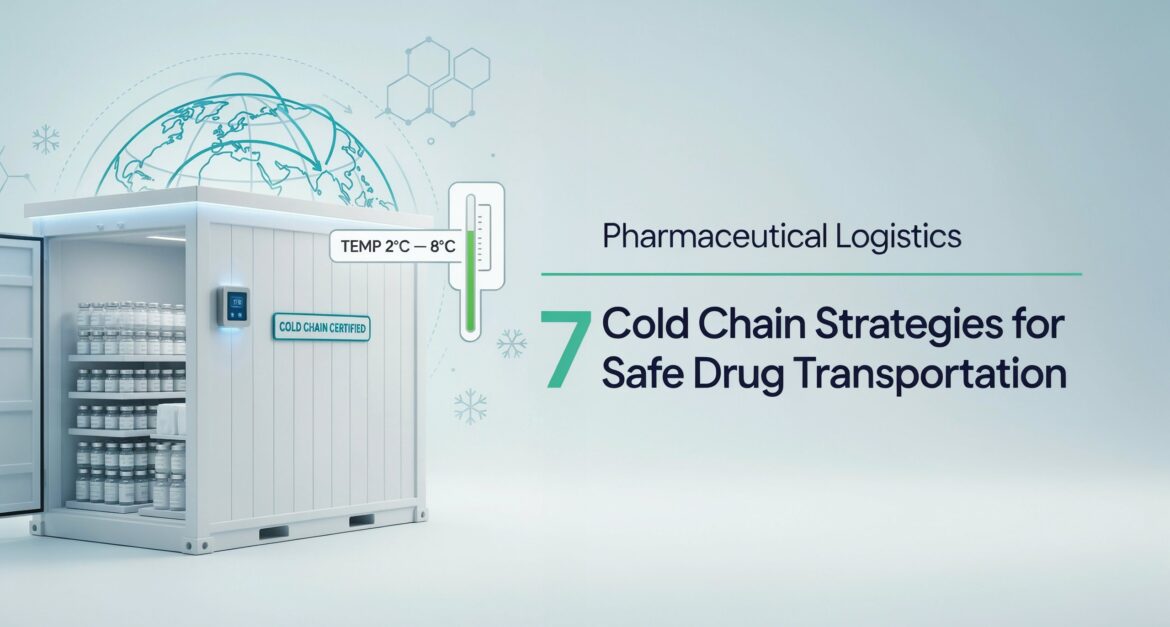
7 Pharmaceutical Logistics Strategies for Safer Drug Transportation
1. Maintain Strict Temperature Control
Define the exact range for each product and hold it from pickup to delivery. This includes the “in-between” moments, such as airport transfers and loading docks, where many failures happen.
2. Use Validated Cold Chain Packaging
Packaging should be tested for the duration, route and weather conditions it will face. A shipper that works for a 12-hour domestic trip may fail on a 48-hour international route in summer heat.
3. Monitor Shipments in Real Time
Sensors and data loggers record temperature and, in many cases, location. Real-time alerts let teams act while there’s still time to save the shipment.
4. Plan Temperature-Controlled Routes
Choose routes with fewer transfers and shorter waiting times. Direct flights and well-planned road legs reduce risk.
5. Prepare Accurate Pharmaceutical Documentation
Mismatched or missing paperwork can hold cargo at customs, and delays are the enemy of the cold chain. Prepare documents before the shipment moves.
6. Use Specialized Cold Chain Facilities
Warehouses, airport handling areas and vehicles should be built for temperature-sensitive cargo, with backup power and trained staff.
7. Establish Contingency Plans for Temperature Excursions
Decide in advance what happens if a shipment drifts out of range: who is alerted, what actions are taken, and how the product’s status is assessed. Written, rehearsed plans cut response time.
How Does the Pharmaceutical Cold Chain Logistics Process Work?
Step 1: Pharmaceutical Shipment Planning
Review the product, destination, timing and regulations. Choose the transport mode and routing.
Step 2: Temperature and Handling Requirements
Confirm the allowed temperature range, handling rules and maximum time out of control.
Step 3: Cold Chain Packaging
Select qualified packaging and coolant for the expected journey.
Step 4: Temperature-Controlled Storage
Hold the product in suitable storage before dispatch and during any layovers.
Step 5: Transportation and Shipment Tracking
Move the cargo while monitoring conditions and milestones.
Step 6: Customs and Regulatory Clearance
Complete import or export procedures with priority handling where possible.
Step 7: Final Delivery and Verification
Deliver to the receiving site and check temperature records to confirm the product stayed within range.
Pharmaceutical Logistics Companies: What Services Do They Provide?
- Pharmaceutical freight forwarding: arranging international air, sea and road movement
- Cold chain transportation: refrigerated and frozen transport
- Temperature-controlled warehousing: storage with monitoring
- Frozen pharmaceutical logistics: sub-zero handling
- Pharmaceutical shipment tracking: visibility of location and temperature
- Customs coordination: clearance support
- Documentation management: records and compliance paperwork
- Last-mile pharmaceutical delivery: final delivery to hospitals, clinics and pharmacies
How Pharmaceutical Cold Chain Logistics Companies Manage Temperature-Sensitive Cargo
Pharmaceutical cold chain logistics companies rely on a combination of equipment, process and people:
- Temperature mapping: identifying hot and cold spots in storage areas and vehicles
- Refrigerated vehicles: transport units with controlled cooling
- Freezer storage: units designed for sub-zero holding
- Data loggers: devices that record temperature throughout the journey
- Real-time temperature alerts: notifications when readings approach limits
- Backup power and refrigeration: protection against outages and equipment failure
- Emergency shipment procedures: predefined responses when something goes wrong
Frozen Pharmaceutical Logistics vs. Refrigerated Pharmaceutical Logistics
| Factor | Frozen Pharmaceutical Logistics | Refrigerated Pharmaceutical Logistics |
| Temperature requirement | Below freezing | Controlled above freezing |
| Main risk | Warming beyond the allowed frozen range | Excess heat, and in some cases accidental freezing |
| Storage | Freezer facilities | Refrigerated facilities |
| Transportation | Specialized frozen transport | Refrigerated transport |
| Monitoring | Continuous temperature monitoring | Continuous temperature monitoring |
| Packaging | Frozen-qualified packaging | Refrigerated cold chain packaging |
Worth knowing: some refrigerated products, including insulin and many vaccines, can be damaged by freezing. “Colder” is not always safer, which is why precise control matters more than simply keeping things cool.
What Products Require Pharmaceutical Cold Chain Logistics?
- Vaccines
- Biological medicines
- Insulin and certain biologics
- Blood products
- Cell and gene therapies
- Temperature-sensitive medicines
- Laboratory and diagnostic products
What Are the Biggest Challenges in Pharmaceutical Logistics?
- Temperature excursions: readings that leave the allowed range
- Transportation delays: missed flights, congestion, weather
- Cold chain breaks: gaps where the product isn’t under control
- Customs delays: time spent waiting for clearance
- Inaccurate documentation: paperwork errors that stall cargo
- Equipment failure: cooling units or sensors that stop working
- Power outages: loss of refrigeration in storage or transit
- Limited shipment visibility: not knowing where cargo is or what condition it’s in
How Technology Improves Pharmaceutical Logistics
- Real-time temperature monitoring: continuous readings during transit
- GPS shipment tracking: live location data
- IoT sensors: connected devices that report conditions automatically
- Automated alerts: immediate warnings to the right people
- Digital documentation: faster, cleaner records
- Cold chain management software: a central view of shipments and compliance
- Predictive analytics: using past data to spot risky routes or seasons
How to Choose Pharmaceutical Logistics Companies
- Cold chain experience: a track record with products like yours
- Temperature-controlled facilities: validated storage and vehicles
- Pharmaceutical handling expertise: trained staff who understand medicines
- Regulatory knowledge: familiarity with health authority expectations
- Real-time tracking: visibility you can access yourself
- Emergency response capabilities: clear actions for failures
- Geographic coverage: reach across your key routes
- Documentation accuracy: consistent, compliant paperwork
- Service reliability: dependable schedules and communication
Pharmaceutical Logistics in Saudi Arabia
Saudi Arabia’s healthcare sector depends heavily on imported medicines and medical products, and its climate adds real pressure. Summer temperatures in many regions are high enough to push unprotected cargo out of range quickly, so planning around outdoor exposure is essential.
Key areas include:
- Pharmaceutical imports: bringing in medicines through airports and ports
- Pharmaceutical exports: moving products out with proper documentation
- Temperature-controlled warehousing: storage near entry points and distribution hubs
- Cold chain transportation: refrigerated road and air legs
- Airport and port handling: minimizing time on the apron and at the dock
- Customs coordination: preparing documents so clearance doesn’t become a bottleneck
- Domestic pharmaceutical distribution: reaching hospitals, clinics and pharmacies across long distances
Pharmaceutical products in the Kingdom are regulated by the Saudi Food and Drug Authority (SFDA), so check current requirements for your product type before shipping.
How Palm Horizon KSA Supports Pharmaceutical Logistics
Palm Horizon KSA helps healthcare businesses plan and coordinate pharmaceutical shipments with temperature, timing and compliance in mind. Support includes:
- Temperature-controlled freight coordination: matching cargo needs with suitable transport
- Pharmaceutical shipment planning: routes, timing and handling requirements
- Cold chain shipment tracking: visibility from pickup to delivery
- Documentation and customs coordination: preparing paperwork to reduce delays
- Transportation management: coordinating carriers and handling partners
- Delivery coordination: managing the final leg to the receiving site
If you move temperature-sensitive products, speak with the Palm Horizon KSA team about a plan built around your product’s exact requirements.
Pharmaceutical Logistics Compliance and Documentation
- Commercial invoice
- Packing list
- Air Waybill or Bill of Lading
- Certificate of origin
- Import and export documentation
- Temperature records: proof the cold chain held
- Product-specific regulatory documents: permits and approvals for the product type
Good Distribution Practice (GDP) guidelines, widely used internationally, set expectations for how medicines should be stored and transported. Providers who work to these standards and hold relevant industry certifications are generally a safer choice.
Pharmaceutical Logistics KPIs to Monitor
| KPI | Why It Matters |
| Temperature compliance rate | Shows how often shipments stay within range |
| On-time delivery rate | Reflects reliability |
| Shipment transit time | Shorter exposure means lower risk |
| Temperature excursion rate | Flags how often limits are breached |
| Cold chain incident rate | Tracks failures beyond temperature alone |
| Documentation accuracy | Fewer errors mean fewer delays |
| Shipment visibility | Measures how well you can track cargo |
| Product loss rate | Shows the financial and patient impact of failures |
How to Prevent Pharmaceutical Cold Chain Failures
- Validate packaging: test it for real route conditions
- Monitor temperature continuously: don’t rely on spot checks
- Select appropriate transportation: match the vehicle or aircraft to the product
- Plan alternative routes: have a backup if delays occur
- Maintain backup refrigeration: protect against power or equipment loss
- Train logistics teams: everyone in the chain should understand the stakes
- Prepare emergency response plans: know exactly what to do when readings drift
Fun Facts About Pharmaceutical Logistics
- Dry ice is very cold. It sublimes (turns straight from solid to gas) at roughly -78.5°C, which is why it is widely used for frozen shipments.
- Some vaccines needed deep-freeze shipping. During the COVID-19 rollout, certain vaccines required ultra-low temperatures, pushing cold chain capacity to the front page of the news.
- Too cold can be as bad as too warm. Insulin and many vaccines can lose effectiveness if they freeze.
- Cell therapies can travel in liquid nitrogen vapor. Some advanced treatments are shipped at temperatures below -150°C, colder than anywhere on Earth’s surface.
- A shipment can have its own “black box.” Data loggers inside the package record the temperature history so the receiver can check what happened on the way.
FAQs About Pharmaceutical Logistics
What Is Pharmaceutical Logistics?
It is the planning, storage, transport, tracking and delivery of medicines and healthcare products under controlled conditions, so quality and safety are maintained.
What Are Pharmaceutical Logistics Companies?
They are logistics providers specializing in medicines, offering temperature-controlled storage and transport, monitoring, documentation and delivery.
What Is Frozen Pharmaceutical Logistics?
It is the handling of medicines that must stay frozen, covering sub-zero storage, transport, packaging and monitoring.
What Is Pharmaceutical Cold Chain Logistics?
It is the continuous chain of temperature-controlled storage and transport that keeps medicines within their required range from origin to destination.
Why Is Temperature Control Important in Pharmaceutical Logistics?
Many medicines lose potency or become unsafe outside their approved temperature range. Control protects patients and the value of the product.
What Do Pharmaceutical Cold Chain Logistics Companies Do?
They plan routes, provide qualified storage and vehicles, use monitoring technology, prepare documents, coordinate customs, and respond to temperature excursions.
What Products Require Cold Chain Transportation?
Vaccines, biological medicines, insulin and certain biologics, blood products, cell and gene therapies, and other temperature-sensitive medicines and diagnostics.
How Are Frozen Pharmaceuticals Transported?
In qualified insulated packaging with suitable coolant, or in freezer-equipped vehicles and containers, with continuous temperature monitoring.
How Are Pharmaceutical Shipments Tracked?
Using data loggers, IoT sensors and GPS devices that record temperature and location, often with alerts sent when readings approach limits.
What Causes Pharmaceutical Cold Chain Failures?
Common causes include delays, equipment failure, power outages, poor packaging, extreme weather, handling errors and documentation or customs holdups.
How Can Businesses Choose the Right Pharmaceutical Logistics Company?
Look at cold chain experience, qualified facilities, regulatory knowledge, tracking capability, emergency response, coverage and documentation accuracy.
Conclusion
Pharmaceutical logistics is not just about moving boxes. It is about protecting the integrity of products that people rely on for their health. A single break in the cold chain can turn a valuable, life-supporting medicine into waste, or worse.
The good news is that most failures are preventable. Strict temperature control, validated packaging, real-time monitoring, smart routing, accurate documentation, specialized facilities and clear contingency plans form a reliable foundation for safe drug transportation.
Choosing the right pharmaceutical logistics company means choosing a partner who understands that every degree counts. Palm Horizon KSA supports healthcare businesses with shipment planning, temperature-controlled freight coordination, documentation, customs coordination, tracking and delivery coordination. Contact the team to discuss how your next temperature-sensitive shipment can arrive safe, compliant and on time.