
Modern supply chains touch dozens of moving parts — suppliers, freight partners, warehouses, customs, ERPs, and last-mile delivery teams — and most of them still don’t talk to each other. Data sits in separate systems, updates arrive too late to matter, and by the time a delay is “visible,” it’s already cost the business money, time, or a customer relationship.
This is the exact problem a supply chain control tower was built to solve. Instead of chasing information across spreadsheets, emails, and disconnected dashboards, businesses get one connected view of everything moving through their network — and the ability to act before small problems become expensive ones.
At Palm Horizon KSA, we work with businesses across the Kingdom that are scaling their logistics operations and hitting the same wall: more shipments, more suppliers, more complexity — and less control. This guide breaks down what a control tower actually is, how it works, and the seven concrete benefits it delivers, approach to focus on what matters most in real-world operations.
What Is a Supply Chain Control Tower?
A supply chain control tower is a centralized platform that pulls supply chain data from different systems — suppliers, warehouses, carriers, and internal operations — into a single, unified view.
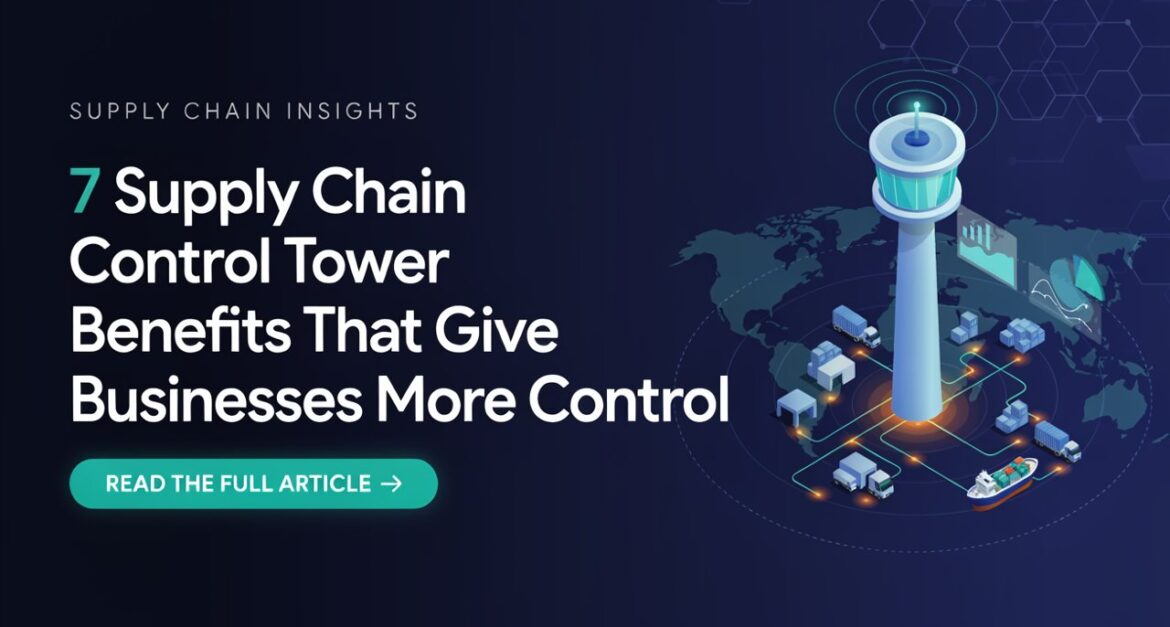
Rather than logging into five different portals to check on an order, a control tower gives teams one place to monitor shipments, inventory, purchase orders, supplier performance, and disruptions as they happen. Think of it as the mission-control room for your entire supply chain: every signal feeds into one screen, and every team works from the same real-time truth.
Fun fact: The term “control tower” is borrowed directly from aviation — air traffic controllers coordinate multiple aircraft using one shared radar view, which is precisely the model supply chain leaders adopted to coordinate multiple shipments, suppliers, and warehouses at once.
What Is a Control Tower in Supply Chain Management?
In supply chain management, a control tower functions as the connective layer between systems that were never designed to work together — your ERP, your warehouse management system (WMS), your transportation management system (TMS), and your suppliers’ own platforms.
It typically covers:
- Real-time supply chain visibility — live status on orders, inventory, and shipments instead of end-of-day reports
- Data integration — pulling structured data from multiple systems into one source of truth
- Exception management — automatically flagging delays, shortages, or anomalies
- Shipment monitoring — tracking freight across carriers, modes, and borders
- Inventory visibility — knowing what’s on hand, in transit, and on order across every location
- Supplier coordination — a shared view between the business and its supplier network
- Predictive insights — using historical and live data to anticipate disruptions before they occur
- Decision-making support — giving planners and managers the context to act quickly, not just data to read
The value isn’t the technology itself — it’s what teams can do once they’re no longer working from fragmented, outdated information.
How Does a Supply Chain Control Tower Work?
A control tower typically operates through seven connected stages:
- Collects data from ERP, WMS, TMS, supplier systems, and carrier feeds.
- Connects information into a single centralized platform, standardizing formats along the way.
- Provides real-time visibility across orders, shipments, and inventory levels.
- Identifies exceptions — delays, shortages, quality issues, or route disruptions — as they happen.
- Analyzes supply chain data to surface patterns, bottlenecks, and recurring risks.
- Delivers alerts and insights directly to the teams responsible for acting on them.
- Supports faster decisions, whether that’s rerouting a shipment, adjusting inventory, or contacting a supplier before a problem escalates.
The result is a shift from reactive firefighting to proactive management — teams see problems while there’s still time to solve them.
7 Supply Chain Control Tower Benefits for Businesses
1. Creates a Centralized View of Operations
Instead of switching between procurement software, freight portals, and warehouse systems, everything — orders, shipments, inventory, supplier status — lives in one dashboard. Teams stop wasting time reconciling numbers across tools and start working from one shared truth.
2. Improves Real-Time Visibility
Businesses can monitor shipments, inventory levels, order status, and supplier activity as it happens, not after the fact. This is the single biggest shift control towers bring: moving from “what happened yesterday” to “what’s happening right now.”
3. Identifies Problems Earlier
Automated alerts flag potential delays, shortages, capacity issues, and other exceptions the moment they emerge — often before a customer or downstream team even notices. Early detection is what separates a minor hiccup from a full-blown supply chain crisis.
4. Supports Faster Decision-Making
When relevant data is centralized instead of scattered across disconnected sources, teams don’t waste time hunting for context. They can evaluate a situation and act on it in minutes rather than days.
5. Improves Supply Chain Coordination
A control tower connects suppliers, logistics providers, warehouses, and internal teams on the same page. Everyone — from procurement to the warehouse floor to the customer service desk — is working from identical, up-to-date information.
6. Helps Reduce Supply Chain Costs
Better visibility surfaces inefficiencies that are otherwise invisible: underutilized transportation routes, excess safety stock, redundant supplier orders, or repeated expedited shipping fees. Fixing these inefficiencies compounds into meaningful savings over time.
7. Improves Customer Service
When a business has tighter control over orders and shipments, it can give customers more accurate delivery windows, respond faster to delays, and resolve issues before customers even ask. Supply chain reliability directly shapes customer trust.
Here’s a simplified illustration of where businesses commonly see the biggest operational gains after adopting a control tower approach:These figures are illustrative rather than pulled from a specific study — actual gains vary by industry, network complexity, and how well the control tower is implemented — but they reflect the general pattern seen across most supply chain modernization projects: visibility and issue resolution tend to improve first and fastest, with cost reductions following as inefficiencies get corrected over time.
What Are the Advantages of a Supply Chain Control Tower?
Beyond the seven core benefits, businesses adopting a control tower typically gain:
- Better visibility across every tier of the supply chain, not just the first mile
- Faster response times to disruptions, delays, and demand shifts
- Improved collaboration between internal teams and external partners
- Better exception management, catching issues before they escalate
- More accurate forecasting, powered by consolidated historical and live data
- Reduced operational inefficiencies across transportation, warehousing, and procurement
- Stronger supply chain resilience against disruptions — geopolitical, seasonal, or logistical
- Data-driven decision-making that replaces guesswork with evidence
For businesses operating across Saudi Arabia and the wider GCC, where supply chains often span multiple ports, customs zones, and long-haul freight corridors, this resilience isn’t a nice-to-have — it’s often the difference between meeting a delivery commitment and missing one.
Palm Horizon KSA vs. Traditional Supply Chain Monitoring
Most businesses don’t move to a control tower from nothing — they move from a patchwork of spreadsheets, carrier portals, and manual check-in calls. Here’s how that traditional approach compares to a control tower model like the one Palm Horizon KSA helps businesses implement:
| Factor | Traditional Monitoring | Control Tower Approach |
| Visibility | Fragmented across systems | Centralized, real-time |
| Issue detection | Reactive, often after impact | Proactive, before escalation |
| Data source | Multiple disconnected tools | Single integrated platform |
| Supplier coordination | Manual emails/calls | Shared live dashboard |
| Decision speed | Slow, requires manual research | Fast, context is immediate |
| Scalability | Breaks down as complexity grows | Built to scale with the network |
The gap isn’t about effort — teams using traditional monitoring often work just as hard, if not harder. The gap is about where the effort goes: chasing information versus acting on it.
How to Build a Supply Chain Control Tower
For businesses ready to move from concept to implementation, the process generally follows these steps:
- Define your supply chain objectives — what problem are you actually solving?
- Map your existing supply chain data — know what you have before integrating it.
- Identify the systems that need integration — ERP, WMS, TMS, and beyond.
- Connect suppliers and logistics partners so data flows both directions.
- Establish real-time data collection, not periodic batch updates.
- Define critical supply chain KPIs so the platform tracks what actually matters.
- Set up alerts and exception management tailored to your risk points.
- Add analytics and predictive capabilities to move from reactive to proactive.
- Train employees — the best platform fails without adoption.
- Continuously monitor and improve performance as the network evolves.
What Technology Powers a Supply Chain Control Tower?
Control towers rely on a stack of interconnected technologies:
- Artificial intelligence for pattern recognition and anomaly detection
- Machine learning to improve predictions as more data flows in
- IoT for real-time asset and shipment tracking
- Predictive analytics to anticipate disruptions before they occur
- Cloud computing for scalable, always-on infrastructure
- Real-time shipment tracking across carriers and modes
- Supply chain analytics to surface trends and inefficiencies
- ERP integration to sync order and inventory data
- TMS and WMS integration to unify transportation and warehouse operations
When Should a Business Consider a Supply Chain Control Tower?
A control tower tends to deliver the most value for businesses managing:
- Multiple suppliers across different regions
- Complex, multi-modal transportation networks
- Global or cross-border supply chains
- Frequent shipment delays or missed delivery windows
- Poor visibility into where inventory or shipments actually are
- Multiple warehouses or distribution centers
- High or unpredictable inventory carrying costs
- Recurring supply chain disruptions
If your team is spending more time chasing status updates than acting on them, that’s usually the clearest sign it’s time.
How to Choose the Right Supply Chain Control Tower
Not all platforms are built the same. When evaluating options, weigh:
- Integration capabilities — can it actually connect to your existing systems?
- Real-time visibility — is data live, or delayed?
- Data quality — garbage in, garbage out still applies
- Analytics depth — descriptive is good; predictive is better
- Exception management — how intelligently does it flag issues?
- Scalability — will it hold up as your network grows?
- Supplier connectivity — can partners plug in easily?
- Ease of use — a powerful platform nobody uses adds no value
- Security — supply chain data is sensitive; treat it that way
Frequently Asked Questions
Is a supply chain control tower only for large enterprises?
No. While large enterprises were early adopters, control tower solutions have become accessible to mid-sized businesses managing multiple suppliers or distribution points, especially as cloud-based platforms lowered the cost of entry.
How is a control tower different from a TMS or WMS?
A TMS manages transportation and a WMS manages warehouse operations — each handles one piece of the puzzle. A control tower sits above both, unifying their data along with ERP and supplier information into one connected view.
Does implementing a control tower require replacing existing systems?
Not usually. Most control towers are designed to integrate with existing ERP, WMS, and TMS systems rather than replace them, acting as a connective layer instead of a system overhaul.
How long does it take to implement a supply chain control tower?
Timelines vary based on the number of systems being integrated and data quality, but most implementations move from planning to live monitoring within a few months rather than years.
Can a control tower help with supplier risk management?
Yes. By centralizing supplier performance data and flagging delays or quality issues early, businesses can identify unreliable suppliers faster and diversify their sourcing before a single point of failure becomes a real problem.
What industries benefit most from supply chain control towers?
Retail, manufacturing, logistics, pharmaceuticals, and any industry with multi-tier supplier networks or complex distribution tend to see the fastest returns, though the underlying benefits apply broadly across sectors.
Final Thoughts
Supply chains don’t fail because businesses lack effort — they fail because critical information arrives too late, in too many places, for anyone to act on it in time. A supply chain control tower closes that gap. It replaces fragmented visibility with one connected view, replaces reactive firefighting with early detection, and replaces slow decision-making with fast, confident action.
For businesses in Saudi Arabia navigating increasingly complex logistics networks, this shift isn’t optional — it’s becoming the baseline expectation for staying competitive. At Palm Horizon KSA, we help businesses build exactly this kind of connected, resilient supply chain operation — one where control isn’t a goal you’re chasing, but a system you already have in place.
If your team is ready to move from scattered visibility to a single source of truth, the right time to start building your control tower is before the next disruption hits — not after.