

Introduction
A truck backs up to the dock. Pallets come off. Someone signs a delivery note. A few hours later, a picker looks for an item the system says is in stock, and it isn’t there.
Where did it go? In many warehouses, the answer is traced back to one moment: receiving.
Receiving is the doorway between the supplier and your inventory. Whatever happens there, whether a miscount, a missed dent or a wrong product code, travels into your stock records and shows up later as stockouts, wrong picks, disputes with suppliers and delayed orders. Fixing an error at the dock takes minutes. Fixing it three weeks later can take days.
An efficient warehouse receiving process protects accuracy from the very first touch. This guide explains what the process is, walks through seven key steps, gives you a simple flow chart and checklist, covers documents, common problems, KPIs and technology, and shows how Palm Horizon KSA supports the logistics around it.
What Is a Warehouse Receiving Process?
The warehouse receiving process is the set of steps a warehouse follows to accept incoming goods: checking documents, unloading, counting, inspecting, matching against orders, recording inventory and approving products for storage.
Why Is the Warehouse Receiving Process Important?
- Accurate stock records: what the system says matches what is on the shelf.
- Early problem detection: shortages, damage and wrong items are caught while the supplier and driver are still reachable.
- Faster flow: goods that are received cleanly reach storage and customers sooner.
- Fewer disputes: documented evidence supports claims and credit requests.
- Better planning: reliable inventory data improves replenishment and fulfillment.
What Happens During Warehouse Receiving?
In short: the shipment arrives, documents are checked, goods are unloaded and counted, quality is inspected, quantities are compared with the purchase order, inventory is recorded and accepted goods move on to putaway.
Who Is Responsible for Warehouse Receiving?
Usually a receiving team led by a supervisor, working with inventory control, quality staff, purchasing and sometimes a transport coordinator. Clear responsibilities matter. When “everyone” is responsible for a discrepancy, nobody follows it up.
What Is the Difference Between Receiving and Putaway?
- Receiving is about verifying and recording what arrived.
- Putaway is about moving the accepted goods to their storage locations.
Receiving ends when goods are approved and recorded. Putaway begins when someone physically places them in storage.
What Is a Receiving Warehouse Process?
A receiving warehouse process is another way of describing the same inbound routine, often used when people focus on the receiving area of the warehouse itself and how it operates day to day.
How the Receiving Warehouse Process Works
- Receiving goods from suppliers: shipments arrive at the dock by truck, container or courier.
- Checking delivery documents: supplier details, order numbers and quantities are verified.
- Inspecting incoming products: packaging, condition and labeling are reviewed.
- Recording received inventory: actual quantities are entered into the system.
- Moving goods to the correct storage area: accepted goods go to the right zone, and held or damaged goods are separated.
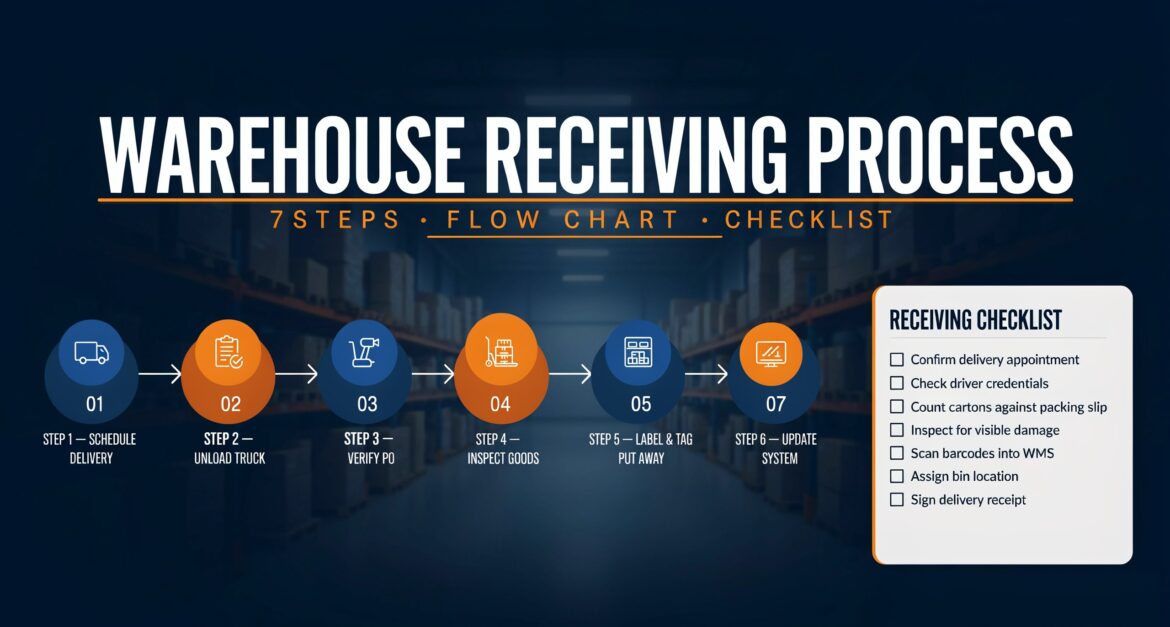
How Does the Warehouse Receiving Process Work? 7 Key Steps
1. Prepare for Incoming Shipments
Review expected deliveries, purchase orders and any advance shipping notices. Make sure dock space, staff and equipment are ready, and plan for special handling such as fragile, heavy or temperature-sensitive items.
2. Verify Supplier and Delivery Documents
Check the delivery note, packing list and order number before unloading. Confirm the supplier, quantities and product descriptions look right.
3. Unload Incoming Goods Safely
Use the correct equipment and follow safety rules. Rushing here causes injuries and damage. Keep the unloaded goods in a clear staging area.
4. Inspect Quantity and Product Condition
Count cartons, pallets or units and look for visible damage, wet packaging, broken seals or wrong labels. Take photos if something looks wrong.
5. Compare Goods Against Purchase Orders
Match what actually arrived against what was ordered. Note shortages, overages and substitutions.
6. Record Inventory in the Warehouse Management System
Enter the received quantities, apply labels and capture batch, lot or expiry details where relevant.
7. Move Accepted Goods to Storage or Putaway
Release approved goods for putaway, and place damaged or questionable goods in a separate hold area until they are resolved.
Warehouse Receiving Process Flow Chart
Here is a simple warehouse receiving process flow chart you can adapt for your site.
Shipment Arrives at Dock
↓
Check Delivery Documents
↓
Unload and Count Goods
↓
Inspect for Damage or Discrepancies
↓
Match Against Purchase Order
↓
┌── Match OK? ──┐
YES NO
↓ ↓
Record and Report and Hold
Label Inventory (damaged, missing,
↓ or incorrect items)
Approve for ↓
Putaway Resolve with Supplier
↓ ↓
Move to Storage Update Records
Simple one-line version: Shipment Arrival → Document Verification → Unloading → Quantity and Quality Inspection → Purchase Order Matching → Inventory Recording → Goods Approval → Putaway
Step 1: Shipment Arrives at the Receiving Dock
Log the arrival time and carrier details.
Step 2: Check the Delivery Documents
Confirm the paperwork before accepting the load.
Step 3: Unload and Count the Goods
Count what is physically present, not what the paperwork says should be there.
Step 4: Inspect Products for Damage or Discrepancies
Check packaging, labels, product condition and any special handling needs.
Step 5: Match the Shipment with the Purchase Order
Compare ordered versus received quantities and descriptions.
Step 6: Record and Label the Inventory
Update the system and label pallets or items so they can be tracked.
Step 7: Approve Goods for Putaway
Release accepted goods to storage.
Step 8: Report Damaged, Missing, or Incorrect Items
Notify the supplier, purchasing and inventory control with evidence, such as photos, counts and document references.
Warehouse Receiving Process Checklist
Use this warehouse receiving process checklist as a starting point and adjust it to your products.
Before the Shipment Arrives
- [ ] Confirm the expected delivery date and time
- [ ] Review purchase orders and advance shipment information
- [ ] Prepare receiving staff, equipment and dock space
- [ ] Check handling requirements for fragile or special goods
During Receiving
- [ ] Verify supplier details and delivery documents
- [ ] Count cartons, pallets or individual items as required
- [ ] Inspect packaging and product condition
- [ ] Compare received goods with the purchase order
- [ ] Record shortages, excess quantities and damaged items
- [ ] Take photographs of visible damage when appropriate
After Receiving
- [ ] Update inventory records
- [ ] Apply product or pallet labels
- [ ] Separate goods requiring further inspection
- [ ] Notify the supplier or relevant team about discrepancies
- [ ] Release accepted goods for putaway
- [ ] File receiving records for future reference
What Documents Are Required for Warehouse Receiving?
| Document | What It Does |
| Purchase order | States what you ordered, in what quantity and at what price |
| Delivery note | Accompanies the goods and lists what the supplier says was sent |
| Packing list | Details contents, quantities and packaging |
| Supplier invoice | Requests payment and should match the order and delivery |
| Advance shipping notice | A heads-up from the supplier about what is coming and when |
| Goods received note | Your internal record of what was actually received |
| Quality inspection records | Evidence of checks, results and any nonconformities |
Keep copies of all of them. When a dispute comes up weeks later, the paper trail often decides who is right.
Common Warehouse Receiving Problems
- Incorrect quantities: more or fewer items than ordered
- Damaged goods: crushed cartons, leaks, broken items
- Missing documentation: no delivery note, no purchase order reference
- Unscheduled deliveries: trucks arriving without notice
- Incorrect product labels: wrong codes, mixed lots, unreadable barcodes
- Inventory data entry errors: typing mistakes or delayed updates
- Limited receiving dock space: queues of trucks and cluttered staging areas
- Delays in inspection and putaway: goods sitting on the dock instead of in stock
How to Improve the Warehouse Receiving Process
- Schedule deliveries in advance: appointment systems reduce dock congestion
- Standardize receiving procedures: everyone follows the same steps
- Use barcode scanning: fewer manual entries, faster verification
- Introduce a warehouse management system: one source of truth for stock
- Train warehouse receiving staff: teach what to check and why
- Track supplier accuracy: identify suppliers who frequently send errors
- Separate damaged and nonconforming goods: keep them away from sellable stock
- Coordinate receiving and putaway teams: avoid goods piling up between the two
How Technology Improves the Receiving Warehouse Process
- Warehouse management systems: manage expected receipts, locations and stock updates
- Barcode and QR code scanning: quick, accurate identification
- RFID inventory identification: reads tags without line-of-sight, useful for fast bulk receiving
- Electronic delivery documentation: digital records are easier to search and share
- Real-time inventory updates: sellable stock appears as soon as it is received
- Automated receiving reports: discrepancy and supplier reports without manual compilation
- Integration with supplier and transport systems: advance notices and delivery data flow into the warehouse system
Manual vs. Automated Warehouse Receiving Process
| Factor | Manual Receiving | Automated Receiving |
| Data entry | Often entered by staff | Captured through connected systems |
| Inventory updates | May take longer | Can update in near real time |
| Error risk | Depends heavily on manual checks | Scanning helps reduce entry errors |
| Document handling | Paper-based or manually stored | Digital records can be centralized |
| Reporting | May require spreadsheets | Reports can be generated by the system |
| Initial investment | Generally lower | May require software and equipment |
A practical note: you don’t need full automation to get big gains. Even adding handheld barcode scanners and a consistent checklist can noticeably cut errors for many warehouses.
Where Does Receiving Time Go? A Quick Illustration
The chart below shows an assumed example for a 10-pallet delivery, comparing the minutes spent on each step in a fully manual process versus one using barcode scanning and a warehouse management system. The numbers are illustrative. Your own times will vary.This example uses assumed numbers: about 110 minutes manually versus about 73 with scanning and a WMS. Physical unloading barely changes, but matching and recording shrink most. Measure your own process to find your real numbers.
Warehouse Receiving KPIs Businesses Should Track
| KPI | Why It Matters |
| Receiving accuracy | Shows how often received counts and records are correct |
| Dock-to-stock time | Measures how long goods take to become available stock |
| Supplier delivery accuracy | Reveals which suppliers send correct, complete shipments |
| Damage and discrepancy rate | Flags quality and handling problems |
| Receiving productivity | Tracks units or pallets received per labor hour |
| Purchase order match rate | Shows how often deliveries match what was ordered |
| Unloading time | Helps with dock scheduling and carrier performance |
| Inventory record accuracy | Confirms system stock matches physical stock |
How Warehouse Receiving Affects Inventory Management
- More accurate stock records: every error avoided at receiving is one less mystery later
- Better inventory visibility: you know what is available, on hold or still on the dock
- Fewer stock discrepancies: fewer cycle count surprises
- Improved replenishment planning: reliable data supports better ordering decisions
- Faster order fulfillment: pickers find what the system promises
- Better coordination between warehouse teams: receiving, putaway, picking and purchasing work from the same facts
Warehouse Receiving Best Practices for Saudi Arabian Businesses
- Plan deliveries around warehouse capacity: coordinate arrival times to avoid long queues, especially in extreme heat when goods and drivers shouldn’t wait outdoors
- Keep shipping and customs documents organized: import paperwork should match delivery records so goods can be received without delay
- Coordinate with suppliers and transport providers: confirm timing, quantities and documents ahead of arrival
- Apply clear inventory identification procedures: consistent labels and codes reduce mix-ups, and some products require specific labeling, including Arabic labeling in some cases, so confirm requirements for your products
- Follow product-specific handling requirements: temperature, fragility and shelf-life rules vary by category
- Maintain accurate receiving records: they support audits, claims and compliance checks
How Palm Horizon KSA Supports Efficient Logistics Operations
Palm Horizon KSA supports the logistics activity around receiving so goods arrive on time, with the right paperwork and fewer surprises. Its support includes:
- Shipment coordination: aligning suppliers, carriers and receiving teams
- Delivery scheduling: helping plan arrivals around your capacity
- Freight and transport coordination: managing the movement of goods to your site
- Shipment tracking: giving visibility into where inbound cargo is and when it will arrive
- Documentation support: helping keep shipment paperwork organized
- Communication across logistics teams: keeping everyone informed when plans change
If late or unclear inbound shipments are slowing your warehouse, talk to the Palm Horizon KSA team about how better coordination can make receiving smoother.
How to Build an Effective Warehouse Receiving Process
Step 1: Review Current Receiving Procedures
Watch how goods really move through the dock and note where steps are skipped or repeated.
Step 2: Identify Delays and Error Sources
Find the top causes of discrepancies, rework and waiting time.
Step 3: Set Standard Receiving Rules
Write down what to check, in what order, and what counts as acceptable.
Step 4: Define Staff Responsibilities
Assign clear owners for unloading, checking, recording, approving and follow-up with suppliers.
Step 5: Introduce Suitable Receiving Technology
Start with the tools that solve your biggest problem, such as scanners, dock scheduling or a WMS.
Step 6: Establish Receiving KPIs
Track accuracy, dock-to-stock time and supplier performance.
Step 7: Review Results and Improve the Process
Hold regular reviews, share results with the team and update the procedure.
Future Trends in Warehouse Receiving
- AI-assisted shipment verification: systems that compare images, documents and orders automatically
- Smart dock scheduling: appointment tools that balance dock capacity, labor and carrier arrivals
- Connected warehouse systems: supplier, transport and warehouse data in one flow
- Automated identification and scanning: gates and tunnels that read many items at once
- Real-time inventory visibility: stock appears the moment it is verified
- Predictive receiving and labor planning: forecasting inbound volumes to staff the dock correctly
Fun Facts About Warehouse Receiving
- The first scanned barcode was on chewing gum. In 1974, a pack of gum was reportedly the first product scanned at a supermarket checkout in Ohio, starting the barcode era that now powers receiving docks worldwide.
- A small error grows fast. A miscounted pallet at receiving can lead to wrong stock levels, a missed customer order and a supplier dispute, all from one moment at the dock.
- Early detection is cheaper. Catching a discrepancy while the driver is still on site is far easier than chasing it weeks later.
- Photos are powerful evidence. A time-stamped picture of damaged packaging often settles a claim faster than any written note.
- Receiving data tells you who your best suppliers are. Warehouses that track delivery accuracy often discover big differences between suppliers they assumed were equal.
FAQs About the Warehouse Receiving Process
What Is a Warehouse Receiving Process?
It is the series of steps used to accept incoming goods: verifying documents, unloading, counting, inspecting, matching against purchase orders, recording inventory and approving goods for storage.
What Are the Main Steps in Warehouse Receiving?
Prepare for shipments, verify documents, unload safely, inspect quantity and condition, compare against purchase orders, record inventory, and move accepted goods to putaway.
What Is a Receiving Warehouse Process?
It is the same inbound routine, viewed from the perspective of the receiving area: accepting supplier deliveries, checking them, recording them and sending them on to storage.
What Is a Warehouse Receiving Process Flow Chart?
It’s a visual diagram showing the sequence of receiving steps and decision points, such as what happens when a delivery matches the purchase order and what happens when it doesn’t.
What Should a Warehouse Receiving Process Checklist Include?
Pre-arrival preparation, document verification, counting, inspection, purchase order matching, discrepancy recording, inventory updates, labeling and release for putaway.
What Documents Are Needed for Warehouse Receiving?
Typically a purchase order, delivery note, packing list, supplier invoice, advance shipping notice, goods received note and quality inspection records.
What Is the Difference Between Receiving and Putaway?
Receiving verifies and records incoming goods. Putaway moves the accepted goods to their storage locations.
How Can Businesses Improve Warehouse Receiving Accuracy?
Use barcode scanning, standard procedures, trained staff, scheduled deliveries, clear documents and regular tracking of supplier accuracy.
Which KPIs Measure Warehouse Receiving Performance?
Receiving accuracy, dock-to-stock time, supplier delivery accuracy, damage and discrepancy rate, receiving productivity, purchase order match rate, unloading time and inventory record accuracy.
How Does a Warehouse Management System Improve Receiving?
It stores expected receipts, supports scanning, flags discrepancies, updates inventory in near real time and produces receiving reports.
Conclusion
Receiving is easy to underestimate. It happens at the back of the building, often under time pressure, with trucks waiting and paperwork in hand. Yet it’s where your inventory truth begins.
A clear warehouse receiving process gives you a reliable foundation: documents are checked, goods are counted and inspected, problems are caught early, records are accurate and accepted products flow smoothly to storage. The tools don’t need to be complicated. A good checklist, a simple flow chart that everyone follows, handheld scanners and a handful of KPIs can transform a messy dock into a dependable one.
Start by watching your own dock for a day. Note where goods wait, where errors appear and where information is lost. Then fix the biggest issue first and measure the result.
Palm Horizon KSA supports businesses with shipment coordination, delivery scheduling, freight and transport coordination, shipment tracking, documentation support and communication across logistics teams, helping inbound goods arrive ready to be received. Contact the team to discuss how to make your inbound logistics smoother and more predictable.