
Introduction: The Invisible Machinery That Separates Leaders from Laggards
There is a quiet revolution happening inside the world’s best logistics companies — and most of it is invisible to the outside world.
You see the truck. You track the parcel. And you sign for the package. But what you never see is the real reason that delivery arrived on time, undamaged, and exactly as promised: a deeply engineered system of decisions, data, technology, and culture that runs 24/7 behind the scenes.
The global logistics industry is worth over $9.6 trillion annually. Yet, fewer than 12% of logistics providers consistently deliver at premium service levels while maintaining healthy margins. The gap between average logistics companies and exceptional logistics companies is not luck — it is architecture.
This article unpacks exactly what separates high-performing logistics companies from the rest, using real-world frameworks, advanced logistics technology, and operational intelligence that leaders like Palm Horizon KSA apply every single day.
Whether you are a supply chain professional, a business owner evaluating a logistics partner, or an investor studying the industry, this guide gives you a rare, behind-the-scenes look at what excellence in logistics actually looks like.
🚀 Fun Fact: DHL processes over 1.8 billion shipments a year — that’s roughly 5 million parcels every single day. Their internal operations run on real-time data updated every 90 seconds across 220+ countries.
What Makes a Logistics Company “High-Performing”?
Before we go behind the scenes, it is worth defining the entity clearly.
A high-performing logistics company is not simply one that delivers packages fast. It is an organization that achieves consistent excellence across five performance dimensions simultaneously:
- Reliability — on-time delivery, damage-free shipments, promise fulfillment
- Scalability — the ability to handle volume spikes without breaking
- Cost efficiency — operational margins that remain healthy even under pressure
- Visibility — full-chain transparency for internal teams and external customers
- Adaptability — the ability to reroute, recover, and respond to disruption in near real-time
High-performing logistics companies treat each of these not as departments, but as interconnected systems. A delay in one area creates a cascade effect. And the best companies engineer buffers, feedback loops, and redundancies so that one disruption never becomes a disaster.
Behind the Scenes: 8 Things High-Performing Logistics Companies Do Differently
1. They Treat Data as the Most Important Asset in Their Fleet
The single biggest differentiator in modern logistics is not the number of trucks or the size of the warehouse. It is data — specifically, how it is collected, processed, and acted upon.
High-performing logistics companies run on real-time logistics data ecosystems. Every vehicle has GPS and telematics transmitting route, speed, fuel load, and temperature. Every warehouse shelf has a sensor. And every shipment has a digital twin that mirrors its physical journey.
The result is what supply chain professionals call end-to-end visibility — a concept that sounds simple but is extraordinarily difficult to execute at scale.
Palm Horizon KSA, for example, integrates IoT-enabled tracking with predictive analytics dashboards so that operations managers can see potential delays before they happen — not after. A truck sitting in unexpected traffic in Jeddah triggers an automated rerouting suggestion before the driver even notices the slowdown.
🎯 Fun Fact: McKinsey research found that companies with advanced logistics analytics capabilities reduce operational costs by 15–20% and improve on-time delivery by up to 30%. Data is not just insight — it is a competitive moat.
2. They Use Predictive Logistics Technology, Not Just Reactive Systems
Most average logistics companies are reactive. Something breaks, they fix it. A delay happens, they notify the customer. A shipment is lost, they investigate.
High-performing logistics companies are predictive. They use machine learning models to forecast demand surges, anticipate weather-related delays, pre-position inventory before the order even arrives, and predict vehicle maintenance needs before a breakdown occurs.
This is the domain of advanced logistics technology — and it is one of the most powerful tools available to modern supply chain operators.
Key predictive logistics tools used behind the scenes include:
- AI-driven demand forecasting that analyzes historical order data, seasonal trends, regional events, and even social media signals to predict what products will need to be where and when
- Predictive fleet maintenance systems that monitor engine health, brake wear, and fuel efficiency to schedule maintenance before failure — reducing unplanned downtime by as much as 40%
- Dynamic routing algorithms that recalculate delivery routes in real time based on traffic, weather, fuel costs, vehicle capacity, and time windows
- Warehouse slotting optimization that uses velocity data to position high-turnover SKUs closest to packing stations, cutting average pick time by 20–35%
The shift from reactive to predictive is not a small operational tweak. It is a complete philosophical reorientation — and it is what separates logistics companies that grow from those that simply survive.
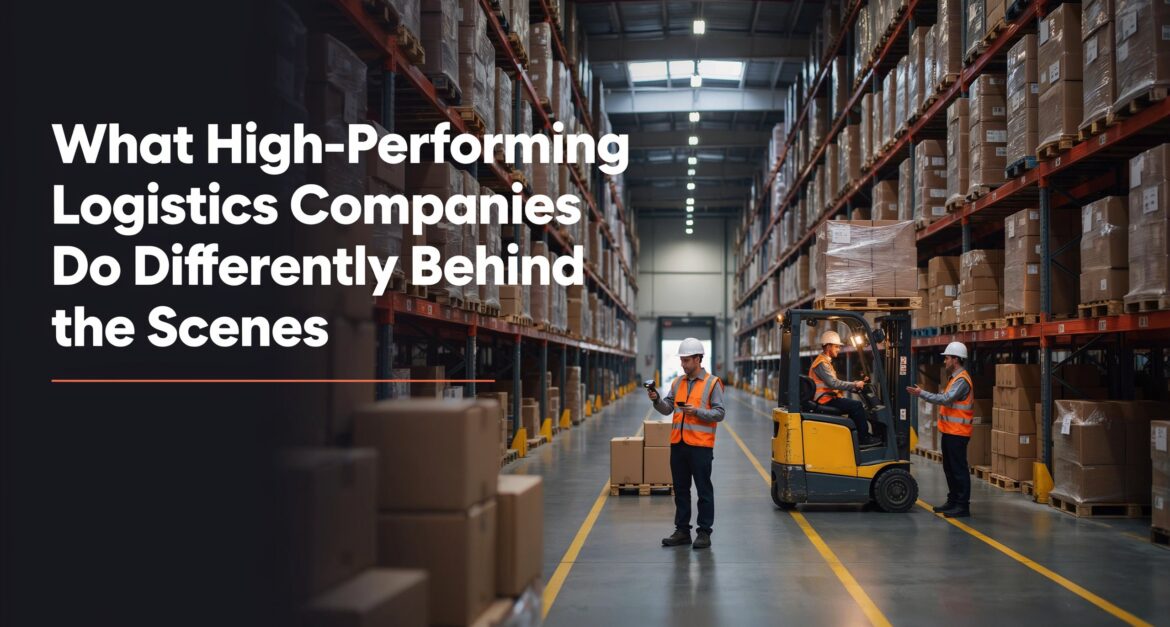
3. Their Warehouse Operations Are Engineered, Not Just Organized
Walk into an average warehouse and you see rows of shelves, workers with clipboards, and forklifts moving slowly between aisles. Walk into a high-performing logistics company’s facility and you see something entirely different: a choreographed system where every square meter has a purpose.
Smart warehouse management is one of the most underappreciated competitive advantages in logistics. The best companies design their warehouses around workflow science, not convenience.
Key behind-the-scenes warehouse innovations include:
- Zone-based picking — grouping orders by zone to eliminate backtracking and reduce walk time
- Goods-to-person automation — conveyor systems and robotic shelving units that bring products to the packer rather than the packer walking to the product
- Cross-docking facilities — where inbound shipments are sorted and transferred directly to outbound vehicles without ever being stored, reducing handling and dwell time dramatically
- Digital receiving processes — barcode and RFID scanning at inbound dock doors that immediately update inventory systems in real time, eliminating manual data entry errors
Palm Horizon KSA integrates smart warehouse management systems (WMS) that give their operations teams a live view of every SKU, every bin location, and every inbound/outbound movement — a level of precision that reduces picking errors to under 0.3%.
🏭 Fun Fact: Amazon’s fulfillment centers use over 750,000 robots globally. But the real secret is not the robots — it is the algorithm that decides where to store each product based on probability of being ordered together. It’s called “random stow” and it sounds chaotic but works brilliantly.
4. They Have Mastered Last-Mile Logistics — The Hardest Part of the Chain
Last-mile logistics is the final leg of a shipment’s journey — from a local distribution hub to the customer’s door. It is also the most expensive, most complex, and most customer-facing part of the entire supply chain.
It accounts for 53% of total shipping costs. And it is where most logistics companies lose both money and customer trust.
High-performing logistics companies treat last-mile delivery not as a cost center but as a strategic investment in brand reputation.
Behind the scenes, they use:
- Dynamic time-window delivery — giving customers the ability to select specific delivery windows and rerouting drivers in real time to honor those windows
- Micro-fulfillment centers — small, urban warehouses positioned inside dense population zones to bring inventory within 30 minutes of delivery addresses, slashing last-mile distance
- Proof of delivery (POD) technology — photo confirmation, digital signatures, and GPS-stamped delivery records that reduce disputes and increase customer confidence
- Route density optimization — packing delivery stops into geographically tight clusters to reduce fuel cost per delivery
- Flexible delivery options — parcel lockers, neighbor delivery, scheduled redelivery — giving customers control reduces failed delivery rates from 8–12% to below 2%
📦 Fun Fact: In Japan, Yamato Transport (known as “Kuroneko”) achieves a 99.8% on-time delivery rate nationwide — in one of the world’s most complex urban environments. Their secret is hyperlocal driver knowledge combined with real-time traffic AI.
5. They Build Supply Chain Resilience Into Every Layer
The COVID-19 pandemic exposed a brutal truth: most supply chains were built for efficiency, not resilience. When disruption hit, entire networks collapsed because they had been optimized to the point of fragility.
High-performing logistics companies build supply chain resilience as a core design principle, not an afterthought.
This means:
- Dual-sourcing critical inputs — never depending on a single carrier, port, or supplier for any mission-critical service
- Buffer stock strategies — maintaining strategic safety stock for high-velocity SKUs even when lean inventory would be cheaper
- Crisis playbooks — documented, rehearsed contingency protocols for port closures, weather events, customs delays, and demand shocks
- Alternative routing networks — pre-established relationships with backup carriers, alternative ports, and secondary freight lanes
- Real-time risk monitoring — using intelligence platforms that track geopolitical events, weather systems, labor disputes, and port congestion and automatically flag risks to operations teams
Palm Horizon KSA invests heavily in resilience infrastructure — not because disruptions are common, but because when they do occur, clients cannot afford surprises.
6. They Use Logistics Technology Integration Across Every System
One of the most common weaknesses in average logistics companies is technology fragmentation: the TMS (Transport Management System) does not talk to the WMS (Warehouse Management System), which does not talk to the ERP, which does not talk to the customer portal.
The result is a company where critical information lives in silos — and decisions get made on outdated or incomplete data.
High-performing logistics companies invest relentlessly in integrated logistics technology stacks where every system communicates in real time.
The core technology architecture of a best-in-class logistics operator looks like this:
- ERP (Enterprise Resource Planning) → financial visibility, procurement, vendor management
- TMS (Transport Management System) → carrier selection, route planning, freight audit, shipping documentation
- WMS (Warehouse Management System) → inventory, labor, slotting, picking, packing, dispatch
- IoT Platform → real-time asset tracking, temperature monitoring, vehicle telematics
- Customer Portal / API Layer → live order status, tracking, invoicing, reporting for clients
- BI & Analytics Platform → performance dashboards, trend analysis, cost optimization reporting
When these systems share data in real time, decisions that used to take hours take seconds. And the entire operation gains an intelligence advantage that compounds over time.
💡 Fun Fact: The first computerized logistics management system was developed by J.C. Penney in 1969. It cost millions of dollars, filled a room, and could track about 1,000 SKUs. Today, a cloud-based WMS subscription does exponentially more for less than $500/month.
7. They Build Cultures of Operational Excellence — Not Just KPI Dashboards
Behind every great logistics operation is not just great technology — it is great people with great habits.
High-performing logistics companies cultivate what operations leaders call a continuous improvement culture. They borrow from lean manufacturing, Six Sigma, and Kaizen principles to eliminate waste, reduce variability, and improve performance incrementally every single day.
This means:
- Daily operational stand-ups where frontline teams review yesterday’s performance, identify root causes of errors, and commit to one improvement today
- Driver and handler incentive programs tied to safety, on-time performance, and fuel efficiency — aligning individual behavior with company goals
- Error root cause analysis — every significant operational error triggers a documented review. The question is never “who did this?” but “what in our process allowed this to happen?”
- Cross-functional training — warehouse staff who understand transport, transport teams who understand warehouse — building systemic understanding across the operation
- Voice of the customer integration — customer feedback loops that flow directly into operational improvement programs, not just sales reports
Palm Horizon KSA operates on the principle that technology amplifies culture — but culture is the foundation. Without a team committed to precision, even the best systems produce average results.
8. They Deliver Transparent, Real-Time Communication to Clients
The final behind-the-scenes differentiator is perhaps the most customer-visible: communication.
Average logistics companies communicate reactively — they tell you when something goes wrong. High-performing logistics companies communicate proactively — they tell you what is happening before you need to ask.
This translates into:
- Live shipment tracking portals with minute-by-minute updates, not just milestone events
- Automated exception alerts when a delay, damage, or customs issue is detected — pushed to the client before they discover it themselves
- Dedicated account intelligence — monthly performance reports showing on-time delivery rates, damage rates, cost trends, and service recommendations
- SLA monitoring dashboards that clients can access directly to see how their account is performing against agreed service levels
- Direct escalation channels — when something goes wrong, clients reach a decision-maker, not a call center
In logistics, trust is built in the invisible moments — the delays you disclosed, the problems you solved before the client noticed, the consistency you maintained when conditions were anything but consistent.
How Advanced Logistics Technology Powers Performance: A Framework
Here is how the technology stack of a high-performing logistics company maps to business outcomes — the PPR (Prominence, Popularity, Relevance) view of logistics technology:
| Technology Layer | Primary Function | Business Outcome |
| AI Demand Forecasting | Predict order volumes by SKU, region, season | 20–40% reduction in overstock/stockouts |
| Real-Time GPS + Telematics | Track every vehicle, every minute | On-time delivery rates above 97% |
| Smart WMS | Manage warehouse labor, inventory, slotting | Pick accuracy above 99.7% |
| Predictive Maintenance AI | Monitor fleet health, schedule pre-emptive service | 35–40% reduction in unplanned breakdowns |
| Dynamic Route Optimization | Recalculate routes based on live conditions | 15–25% reduction in fuel and labor cost |
| IoT Cold Chain Monitoring | Monitor temperature and humidity in transit | Near-zero spoilage for temperature-sensitive cargo |
| Integrated TMS/ERP | Unified financial and operational data | 30–50% faster invoice processing and reconciliation |
| Customer Visibility Portal | Real-time client access to shipment data | 60–70% reduction in inbound customer service calls |
Industries Served by High-Performing Logistics Companies
The operational excellence we have described is not industry-specific — but different sectors demand different capabilities.
Retail and E-Commerce The highest-volume, highest-velocity logistics environment. Demands: fast last-mile delivery, returns management, demand forecasting, and peak-season scalability.
Healthcare and Pharmaceuticals Zero-tolerance for temperature deviation or delay. Demands: cold chain logistics, strict compliance documentation, and real-time condition monitoring for controlled substances and vaccines.
Food and Beverage Time-sensitive, perishable, heavily regulated. Demands: FIFO inventory management, cold chain integrity, expiry date tracking, and rapid replenishment cycles.
Manufacturing and Industrial Complex inbound supply chains, just-in-time delivery requirements. Demands: supplier coordination, raw material tracking, customs brokerage, and parts logistics precision.
Construction and Infrastructure Project-based, bulk cargo, deadline-driven. Demands: heavy freight capability, project logistics coordination, oversized cargo handling, and site-delivery precision.
Oil, Gas, and Energy Remote locations, specialized cargo, critical equipment. Demands: hazardous materials handling, remote delivery capability, specialized lifting equipment, and cross-border freight expertise.
Palm Horizon KSA: What Excellence Looks Like in the Saudi Market
Palm Horizon KSA is a blend of cutting-edge logistics technology, local mastery, and uncompromising dedication to results. The needs of logistics providers are greater than ever in the Kingdom of Saudi Arabia, where the infrastructure is transforming at an unprecedented speed as part of Vision 2030.
Palm Horizon KSA implements all of the behind-the-scenes disciplines outlined in this article: integrated technology stacks, smart warehouse management, predictive fleet operations, real-time client visibility, and a culture that views operational excellence as a standard, not a marketing pitch.
The capacity to work with a logistics provider that invests at this level is not only convenient for a business in Saudi Arabia, the GCC, or wider MENA markets, it’s a business performance differentiator.
How High-Performing Logistics Companies Compare to Average Providers
| Performance Area | Average Logistics Provider | High-Performing Logistics Company |
| On-Time Delivery | 85–90% | 97–99.5% |
| Shipment Visibility | Milestone-only updates | Real-time, end-to-end tracking |
| Damage Rate | 1.5–3% | Below 0.3% |
| Technology Integration | Siloed, partial | Fully integrated TMS/WMS/ERP/IoT |
| Demand Forecasting | Manual, spreadsheet-based | AI-driven, automated |
| Customer Communication | Reactive (after problems) | Proactive (before problems) |
| Supply Chain Resilience | Single-source, lean-only | Multi-source, buffer-protected |
| Continuous Improvement | Ad hoc | Systematic, daily, documented |
| Last-Mile Performance | Standard routes, fixed windows | Dynamic routing, flexible options |
| Data Analytics | Monthly reports | Real-time dashboards |
The performance gap between these two columns is not imaginary — it is the difference between a logistics operation that enables business growth and one that simply processes shipments.
Implementation Roadmap: How Businesses Can Access High-Performance Logistics
If you are a business evaluating logistics partnerships or looking to upgrade your supply chain performance, here is a practical implementation approach:
Phase 1: Audit (Weeks 1–2) Map your current logistics pain points: where do delays occur? Where is visibility lost? What is your current damage rate and on-time performance? Establish baseline KPIs.
Phase 2: Partner Evaluation (Weeks 3–4) Evaluate logistics providers not just on price but on technology capability, resilience infrastructure, real-time visibility tools, and cultural alignment with operational excellence.
Phase 3: Pilot Integration (Weeks 5–8) Run a pilot on one freight lane or one product category with your new logistics partner. Measure performance against baseline. Identify integration requirements between your systems and the provider’s.
Phase 4: Full Deployment (Months 3–6) Expand to full operations. Establish SLA dashboards, escalation protocols, and monthly performance reviews. Begin accessing analytics to drive continuous improvement.
Phase 5: Optimization (Ongoing) Use data from your logistics partner to refine demand forecasting, adjust inventory positioning, optimize packaging for freight efficiency, and improve overall supply chain performance quarter over quarter.
Frequently Asked Questions (FAQ)
Q1: What is the single most important technology investment a logistics company can make?
It depends on the current gap in your logistics operations but for most operations, the ROI from real-time visibility infrastructure is quickest and most measurable, from GPS Telematics, WMS integration and customer facing tracking. It also enhances the efficiency of the operations, lowers customer service expenses and raises client retention rates. Advanced logistics technology investments should always start with visibility before automation.
Q2: How do high-performing logistics companies handle supply chain disruptions?
Through pre-built resilience architecture: dual-sourced carrier relationships, alternative routing options, documented crisis protocols, and real-time risk monitoring tools. When disruption occurs, the response is not improvised — it follows a rehearsed playbook. The key difference is that elite logistics companies view disruption as inevitable and plan for it, rather than treating it as an exception.
Q3: What is last-mile logistics and why does it cost so much?
Last mile logistics is the last leg of delivery from the local distribution center to the customer’s door. It costs a lot because of high stop-density, low package weight per vehicle, time window constraints and failed delivery rates. It can make up to 53% of the total shipping cost. To minimize last-mile delivery expenses, logistics companies aim to optimize their routes, offer flexible delivery methods, and use micro-fulfillment centers that are strategically located near demand centres.
Q4: How does a company know if its current logistics provider is underperforming?
Key warning signs include: on-time delivery rates below 94%, reactive communication (you hear about problems from customers before your provider tells you), lack of real-time shipment visibility, damage rates above 1%, manual invoicing processes, and no access to regular performance reporting. If any of these apply, you are likely leaving significant operational value on the table.
Q5: What is predictive logistics and how is it different from traditional logistics planning?
Traditional logistics planning is backward-looking — it uses historical data to set fixed schedules and routes. Predictive logistics uses AI and machine learning to forecast demand, anticipate disruptions, and optimize decisions in advance. It is the difference between reacting to a stockout and preventing it, or discovering a vehicle breakdown and predicting it 72 hours in advance. Predictive logistics technology allows companies to operate proactively rather than reactively — a fundamental performance advantage.
Q6: How does Palm Horizon KSA use advanced logistics technology in Saudi Arabia?
Palm Horizon KSA integrates a full suite of logistics technology including real-time GPS tracking, smart warehouse management systems, AI-driven route optimization, and a client visibility portal that provides live shipment status across the supply chain. Operating in the KSA and broader GCC market, Palm Horizon KSA applies these capabilities to serve industries ranging from retail and e-commerce to healthcare, industrial, and energy — delivering high-performance logistics outcomes in one of the region’s most demanding and fastest-growing markets.
Q7: Is logistics technology only accessible to large companies?
No. Cloud-based logistics technology has fundamentally democratized access to advanced tools. Small and mid-sized businesses can now access AI-powered demand forecasting, real-time tracking, and dynamic route optimization through SaaS platforms and logistics partnerships — capabilities that were once available only to global enterprises with nine-figure technology budgets. The real barrier today is not cost but organizational readiness and partner selection.
Conclusion: The Invisible Advantage That Drives Visible Results
The difference between a good logistics company and a great logistics company is almost entirely invisible to the naked eye.
You cannot see the AI model predicting which SKUs need to be replenished in three days. You cannot see the route optimization algorithm quietly rerouting a driver around a traffic incident you never knew about. And you cannot see the warehouse slotting strategy that shaved four seconds off every single pick cycle. You cannot see the resilience protocol that activated the moment a port showed signs of congestion.
But you feel all of it — in on-time deliveries, in undamaged goods, in supplier relationships that trust you because your logistics never let them down, and in customers who keep coming back because the experience was flawless.
That is what high-performing logistics companies build behind the scenes. Not magic — architecture.
Palm Horizon KSA is built on this architecture. Every system, every process, every piece of advanced logistics technology is deployed with one purpose: to make your supply chain a competitive advantage rather than a constraint.
In a market as dynamic, ambitious, and fast-moving as Saudi Arabia, you cannot afford average logistics. You need a partner who invests behind the scenes so that every result in front of your customers is extraordinary.