
Introduction
The truck arrives. The driver wants a signature. A corner of one pallet is crushed, two cartons feel wet and the count looks one short. The receiving team has about five minutes to decide what to write on the delivery receipt.
What happens next often decides whether the business can recover anything at all.
Cargo damage, loss and delays are an ordinary part of moving goods, even when carriers are careful. What separates businesses that recover eligible losses from those that absorb them is rarely luck. It’s process: noticing problems quickly, recording them properly, collecting evidence, reading the contract, meeting deadlines and communicating clearly.
That process is freight claims management. This guide explains what it is, seven steps to handle a claim, common claim types, the documents you’ll need, challenges, best practices, KPIs, prevention tips and how Palm Horizon KSA supports freight claim coordination. It is general information, not legal advice, and outcomes always depend on the facts, the agreements, the evidence and the applicable laws.
What Is Freight Claims Management?
Freight claims management is the process of identifying, documenting, submitting, tracking and resolving claims related to damaged, lost, short or delayed cargo, and related shipping disputes. It covers everything from the first notice at delivery to the final decision and the lessons learned afterward.
What Is Freight Claim Management?
Freight claim management is simply a close variation of the same phrase. Both describe how a business handles transportation claims, and people use them interchangeably. There’s no separate service behind either one.
Why Is Freight Claims Management Important?
- Recovering eligible losses: a well-documented claim has a better chance of being considered fairly.
- Meeting deadlines: many agreements and rules have short notice and filing periods.
- Accountability: clear records show where problems occur.
- Spotting patterns: repeated issues on a route, carrier or packaging type become visible.
- Protecting customer relationships: quick, organized responses help keep customers informed.
How Does the Freight Claims Management Process Work?
At a high level: a problem is noticed, the cargo condition is recorded, evidence and documents are gathered, the contract and insurance are reviewed, a claim is submitted, communication continues until a decision and the result is reviewed to prevent a repeat.
Who Is Responsible for Managing Freight Claims?
It depends on the shipment terms. The party who holds the risk or the contract with the carrier, usually the shipper, consignee or their insurer, files and manages the claim. In practice, logistics, finance, customer service and sometimes a freight forwarder all play a part, so assigning clear ownership is important.
When Should a Freight Claim Be Filed?
As soon as damage, loss or shortage is discovered, and always within the deadlines in your contract, the carrier’s terms and the applicable rules. Some time limits can be short, so don’t wait until you’ve finished investigating internally. Notify first, then complete the paperwork.
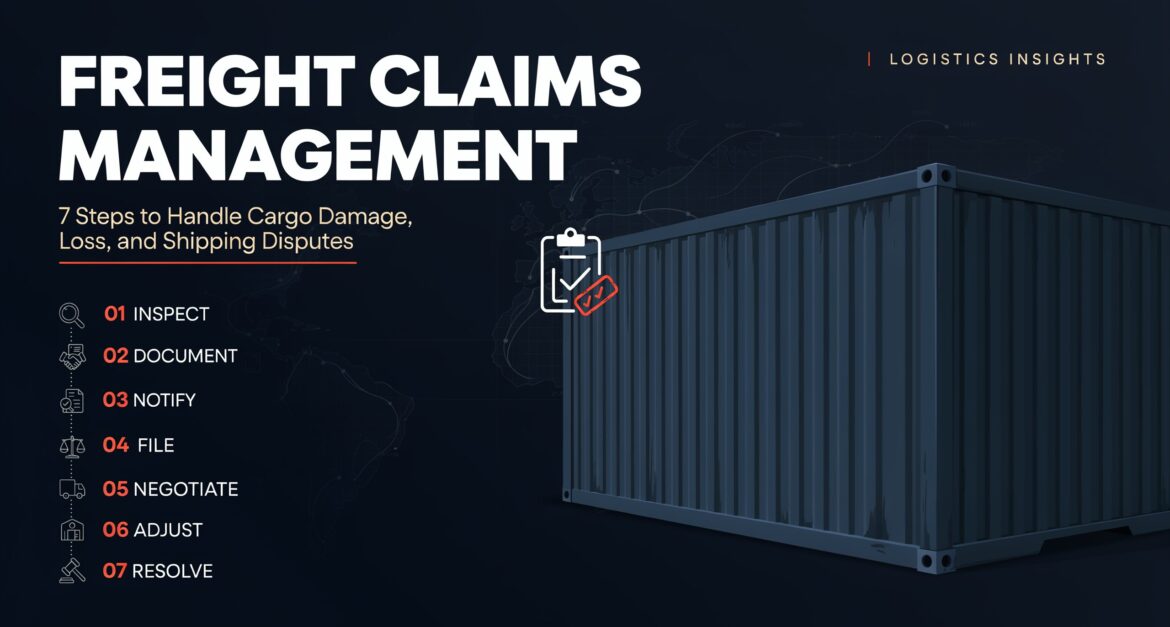
Freight Claims Management: 7 Steps to Handle Shipping Claims
1. Identify and Report the Freight Damage or Loss
Check cargo at delivery and report any problem immediately. Quick notice protects your position.
2. Inspect the Cargo and Record the Condition
Examine the packaging and goods. Note visible damage, shortages, wet or crushed cartons and signs of mishandling. Record exceptions on the delivery document before signing.
3. Collect Evidence and Supporting Documents
Gather photographs, the delivery receipt, shipping documents, inspection reports and correspondence. Keep damaged goods and packaging where possible.
4. Review Carrier Contracts and Insurance Coverage
Check the carrier’s liability terms, notice periods, limits and any cargo insurance you hold. This tells you who to claim from and what to expect.
5. Prepare and Submit the Freight Claim
Complete the claim form or letter with the facts, amount and supporting evidence, and submit it within the required time.
6. Communicate with the Carrier and Track Claim Progress
Keep a log of every message, follow up regularly and respond quickly to requests for more information.
7. Review the Outcome and Improve Future Shipping Procedures
Whether the claim succeeds or not, record what happened and use it to improve packaging, carrier selection, handling and documentation.
What Are the Common Types of Freight Claims?
- Cargo damage claims: goods arrive broken, crushed, wet or otherwise damaged
- Lost freight claims: a shipment or package never arrives
- Shortage and missing cargo claims: fewer items than shipped
- Delayed shipment claims: late delivery causing loss, where applicable under the agreement
- Improper handling claims: damage linked to rough handling, poor stowage or wrong equipment
- Temperature-related cargo claims: products affected by heat, cold or humidity outside the required range
- Packaging and loading damage claims: damage linked to inadequate packing or loading issues, where responsibility must be carefully established
The availability of a claim and the possibility of compensation depend on the facts, applicable agreements, evidence and relevant laws.
What Documents Are Required for Freight Claims Management?
| Document | Why It Matters |
| Commercial invoice | Shows the value and terms of the goods |
| Bill of Lading or Air Waybill | The transport contract and evidence of what was shipped |
| Packing list | Confirms the contents and quantities |
| Delivery receipt and proof of delivery | Shows what was received and any exceptions noted |
| Cargo inspection report | Independent or internal record of the cargo condition |
| Photographs of damaged goods | Visual evidence of damage and packaging |
| Carrier correspondence | Records of notice, replies and agreements |
| Freight insurance policy | Defines coverage, deductibles and procedures |
| Repair, replacement or loss valuation records | Supports the amount claimed |
How to File a Freight Claim Step by Step
Step 1: Notify the Carrier or Relevant Party
Send written notice as soon as possible, describing what happened.
Step 2: Record Visible Damage or Shortages
Note exceptions on the delivery receipt and take dated photos.
Step 3: Preserve Packaging and Cargo Evidence
Don’t discard damaged packaging or goods until the carrier or insurer has had the chance to inspect, where required.
Step 4: Gather Shipment and Commercial Documents
Collect the invoice, packing list, transport document and proof of delivery.
Step 5: Check Claim Deadlines and Contract Requirements
Read the carrier’s terms, your agreement and any insurance conditions for notice and filing periods.
Step 6: Submit a Complete Claim
Include the claim form, supporting documents, valuation and a clear explanation.
Step 7: Keep Records of All Communications
Save emails, call notes and acknowledgments in one place.
Step 8: Follow Up Until a Decision Is Issued
Don’t assume silence means progress. Follow up and keep your records current.
Common Freight Claim Management Challenges
- Missing or incomplete documentation: gaps weaken the claim
- Missed claim filing deadlines: some deadlines are short and strict
- Disputes over responsibility for damage: shipper, carrier, packer and handler may each point elsewhere
- Insufficient evidence of cargo loss: no photos, no exceptions noted, no counts
- Conflicting shipment records: documents that don’t match each other
- Unclear carrier liability terms: limits and exclusions that surprise shippers
- Delays in claim investigation: slow responses that stretch resolution time
- Disagreements over cargo valuation: differences between invoice value, replacement cost and the carrier’s limits
Freight Claims Management Best Practices
- Inspect shipments at delivery: don’t leave checking for later
- Record exceptions on delivery documents: a “clean” signature can make a later claim harder
- Photograph cargo damage immediately: include packaging, labels and close-ups
- Maintain a centralized claims register: one list of all claims, dates, amounts and status
- Set clear internal reporting procedures: staff should know who to tell and how fast
- Track claim deadlines: use reminders for notice and filing dates
- Coordinate with carriers and insurers: early, clear communication helps
- Review repeated claims to identify patterns: fix the cause, not just the symptom
Freight Claims Management vs. Freight Claim Management
They are two forms of the same idea: handling transportation claims from first notice to final resolution. This article uses both naturally because people search both ways, and they refer to one process, not two different services.
How Freight Claims Management Helps Control Business Costs
- Recovering eligible losses: properly documented claims can recover some or all of an eligible loss
- Reducing administrative rework: a standard process avoids chasing missing information
- Improving shipment accountability: records show where in the chain a problem occurred
- Identifying recurring cargo damage: patterns point to packaging, route or handling issues
- Strengthening carrier performance reviews: claims data adds facts to carrier discussions
- Supporting better shipping decisions: insight on risk helps decide on packaging, insurance and carrier choice
Not every claim will be approved, and not every loss is recoverable.
Why Insurance and Limits Matter: A Quick Illustration
Carriers’ liability is often limited by contract or by international rules, and the limit may be well below the goods’ value. Here is an assumed example for a USD 20,000 shipment weighing 500 kg, where the carrier’s liability is limited to USD 3 per kg, while cargo insurance covers the full insured value. The figures are invented to show the gap. Real limits vary widely by mode, contract and jurisdiction.
This example is simplified and for illustration only. Always review your contract, the transport document and your insurance policy to see what actually applies.
Freight Claims Management for Businesses in Saudi Arabia
- Managing claims for international shipments: cross-border cargo often involves several parties and contracts
- Coordinating cargo inspections and evidence: arrange inspections at the port or warehouse promptly, and keep clear photo and document records
- Reviewing shipping documents and contract terms: check the Bill of Lading or Air Waybill, forwarder terms and carrier conditions
- Communicating with freight forwarders and carriers: share facts early and keep written records
- Checking applicable insurance requirements: confirm your coverage, deductibles and notice procedures
- Maintaining records for cross-border shipments: keep documents organized for both operations and finance
- Understanding relevant Saudi regulations and claim deadlines: rules and time limits depend on the transport mode, agreement and applicable law, so confirm them with a qualified adviser
Freight Claims Management for Different Transport Modes
Air Freight Claims Management
Air cargo is often high-value and time-sensitive, and notice periods can be short. Record damage at delivery and report quickly.
Ocean Freight Claims Management
Sea freight claims may involve containers, seals, stowage and long transit times. Container and seal details, survey reports and the Bill of Lading are especially important.
Road Freight Claims Management
Road claims often involve proof of delivery, driver and vehicle details, loading condition and securing methods.
Multimodal Freight Claims Management
When cargo changes mode, it can be harder to identify where damage occurred. Records at each handover become critical.
Evidence, reporting procedures, liability terms and claim deadlines may vary according to the transport mode, carrier agreement and applicable legal framework.
How Freight Claims Management Software Can Help
- Centralized claim records: one place for claims, documents and notes
- Automated deadline reminders: alerts before notice and filing periods end
- Digital document storage: quick access to photos, invoices and reports
- Claim status tracking: see which claims are open, pending or resolved
- Carrier communication records: a clear history of messages
- Claims reporting and performance analysis: insights by carrier, route and cause
- Integration with transportation management systems: link claims to shipment records
Software can organize the workflow, but it doesn’t replace careful evidence collection or the need to follow contractual and legal requirements.
Freight Claims Management KPIs Businesses Should Track
| KPI | Why It Matters |
| Number of freight claims filed | Shows overall claim volume |
| Claim frequency per shipment | Reveals how often shipments run into problems |
| Average claim resolution time | Measures how long recovery takes |
| Total value of claims submitted | Shows financial exposure |
| Value of claims recovered | Shows actual recovery |
| Claim acceptance rate | Indicates the strength of your documentation and process |
| Cargo damage rate | Tracks the underlying problem |
| Repeat claims by carrier or route | Highlights recurring issues |
How to Prevent Future Freight Claims
- Improve cargo packaging and protection: match packaging to the cargo, mode and route
- Verify loading and securing procedures: poor stowage causes many damage claims
- Select suitable transport and handling options: fragile, heavy or temperature-sensitive cargo needs the right equipment
- Confirm shipment details before dispatch: accurate weights, counts and documents
- Improve cargo inspection procedures: check at pickup and at delivery
- Train staff to report damage promptly: quick reporting protects your position
- Monitor carrier performance: use claim data in carrier reviews
- Analyze claim trends and correct recurring problems: fix root causes
How Palm Horizon KSA Can Support Freight Claim Coordination
Palm Horizon KSA supports businesses by keeping shipment information and communication organized, which is the foundation of any claim. Its support includes:
- Coordinating shipment information: keeping details consistent across parties
- Organizing relevant shipping documents: making them easier to find when needed
- Communicating with logistics partners: helping information flow between carriers, forwarders and receivers
- Sharing shipment status updates: keeping a clear record of what happened and when
- Supporting freight forwarding coordination: aligning transport arrangements and documents
- Helping businesses maintain organized shipment records: a tidy record trail makes issues easier to review
If you want better records and clearer communication across your shipments, talk to the Palm Horizon KSA team.
How to Build a Freight Claims Management Process
Step 1: Establish a Claim Reporting Policy
Define what counts as a reportable incident, who to notify and how quickly.
Step 2: Assign Responsibility for Claim Handling
Name an owner for each stage: receiving, documentation, carrier contact and finance.
Step 3: Create a Standard Evidence Checklist
List the photos, documents and notes required for every claim.
Step 4: Maintain a Central Claims Register
Track each claim’s dates, amount, status and next action.
Step 5: Define Carrier Communication Procedures
Agree how and when to contact carriers, and keep written records.
Step 6: Track Deadlines and Claim Status
Set reminders for notice and filing periods and follow-up dates.
Step 7: Review Outcomes and Identify Improvements
Meet regularly to review claims, causes and fixes.
Future Trends in Freight Claims Management
- AI-assisted document review: tools that check claims for missing information
- Digital cargo inspection records: photos, timestamps and notes captured on mobile devices
- Automated claims workflow management: reminders and tasks handled by software
- Real-time shipment visibility: better evidence of where and when issues occurred
- Data-driven damage prevention: using claim data to guide packaging and routing decisions
- Integrated freight and insurance systems: smoother communication between shipping and insurance records
Fun Facts About Freight Claims Management
- A signature can speak louder than words. Signing a delivery receipt without noting visible damage can make it harder to prove later that the damage existed at delivery.
- Time limits can be surprisingly short. Some notice periods in transport agreements and rules are measured in days, which is why speed matters.
- A photo is worth a lot. A dated photograph of damaged packaging often carries more weight than a long written description.
- Damaged goods can still be evidence. Keeping broken items and packaging until inspections are complete can be crucial.
- Claims data tells a story. Businesses that track claims often discover that a small number of routes or packaging types cause most of their problems.
FAQs About Freight Claims Management
What Is Freight Claims Management?
It is the process of identifying, documenting, submitting, tracking and resolving claims for damaged, lost, short or delayed cargo and related shipping disputes.
What Is Freight Claim Management?
It is another way to refer to the same process. The terms are used interchangeably.
What Are the Most Common Freight Claims?
Cargo damage, lost freight, shortages or missing cargo, delays, improper handling, temperature-related damage and packaging or loading damage.
What Documents Are Needed to File a Freight Claim?
Typically the commercial invoice, Bill of Lading or Air Waybill, packing list, delivery receipt with any exceptions, inspection report, photos, carrier correspondence, insurance policy and valuation records.
How Long Do Businesses Have to File a Freight Claim?
It depends on the contract, the transport mode and the applicable rules. Some notice periods are very short, so report problems immediately and check the exact deadlines.
Who Is Responsible for Damaged Freight?
It depends on the facts, the shipping terms and the agreements. Responsibility may lie with the carrier, shipper, packer or another party, and sometimes it is shared.
What Is the Difference Between a Freight Claim and an Insurance Claim?
A freight claim is usually made against the carrier under the transport contract and applicable rules. An insurance claim is made under a cargo insurance policy. Some losses may involve both.
Can a Business File a Claim for Missing Cargo?
Often yes, subject to the contract, the evidence and any deadlines. Report the shortage promptly and provide documents that show what was shipped and what arrived.
How Can Businesses Reduce Freight Claims?
Improve packaging, check loading and securing, choose suitable carriers and handling, confirm shipment details, inspect cargo, train staff and review claim patterns.
How Can Freight Claims Management Software Help?
It centralizes records, stores documents, sends deadline reminders, tracks claim status and produces reports, though it doesn’t replace good evidence or legal and contractual requirements.
How Can Saudi Businesses Manage International Freight Claims?
Review contracts and insurance, record cargo condition at delivery, gather documents, communicate promptly with forwarders and carriers, keep organized records and confirm deadlines and legal requirements with a qualified adviser.
Conclusion
Most freight claims are won or lost in the first few hours. A note on the delivery receipt, a handful of photos, a quick message to the carrier and a folder with the right documents often matter more than any negotiation that follows.
Good freight claims management turns that moment from a scramble into a routine. You inspect on delivery, record exceptions, collect evidence, read the contract, meet the deadlines, communicate clearly and learn from each outcome. Over time, the same data helps you prevent claims, improve packaging, choose carriers more carefully and decide where insurance makes sense.
Nothing guarantees every claim will be approved, but a consistent process gives you the best chance of a fair outcome and the clearest view of your shipping risks.
Palm Horizon KSA supports businesses with shipment information coordination, document organization, communication with logistics partners, status updates and freight forwarding coordination, helping keep the records that claims depend on. Contact the team to discuss how better coordination can reduce avoidable cargo risks.