
Introduction: The Hidden Crisis Behind Every Empty Plate
Picture this: It’s a Friday evening in Riyadh. The dining room is packed. The kitchen is firing on all cylinders. And then — the chef discovers the fresh produce order never arrived. The fish supplier ran three hours late. The imported olive oil is stuck in customs.
The guests don’t see any of this. But they feel it. In the longer wait times, “we’re out of that tonight.” In the one-star review that follows the next morning.
This is not a rare scenario. It is the daily reality for thousands of restaurants and food businesses across Saudi Arabia and the wider GCC region. The food service industry operates on razor-thin margins, high perishability timelines, and customer expectations that have never been higher. Yet the supply chain that feeds it all remains one of the most underinvested and poorly managed components of the business.
The problem is not the food. The problem is the flow.
And that is precisely where professional logistics support services step in — not as a luxury, but as the operational backbone that separates thriving food businesses from struggling ones.
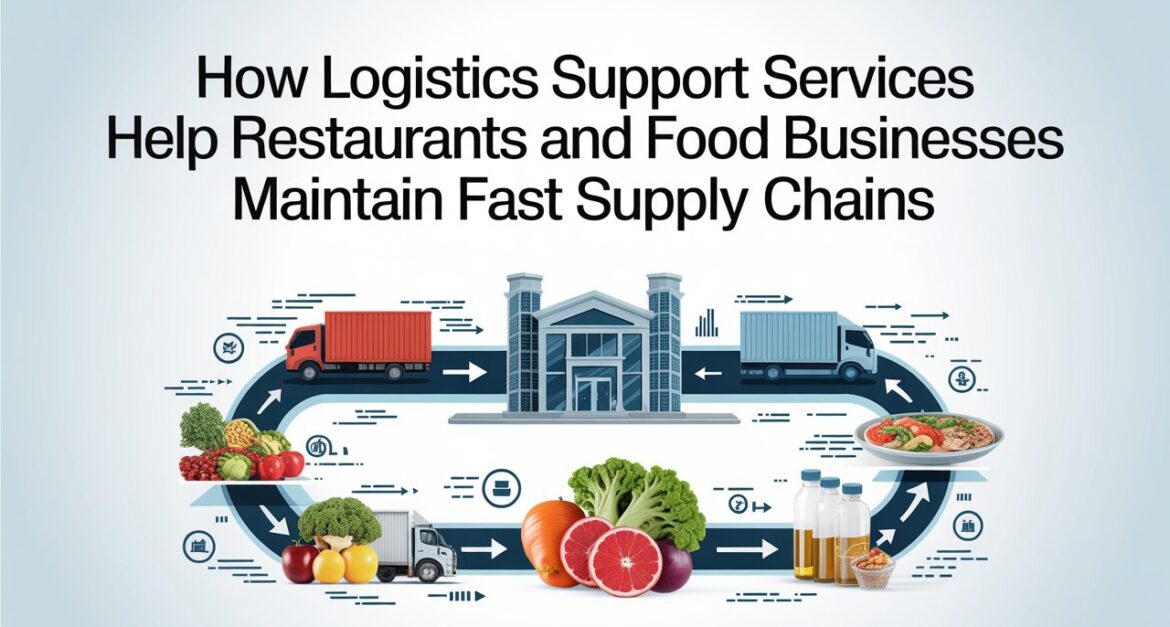
This article breaks down exactly how logistics support services power fast, reliable, and scalable supply chains for restaurants and food businesses — drawing on real-world applications, industry data, and the framework that Palm Horizon KSA uses to serve clients across the region.
🍕 Fun Fact: A single full-service restaurant in a major city may require coordination with up to 47 different suppliers on a weekly basis. Managing that manually, without a logistics partner, is the equivalent of conducting an orchestra blindfolded.
What Are Logistics Support Services in the Food Industry?
Logistics support services, in the context of restaurants and food businesses, refer to the end-to-end management of goods movement — from supplier sourcing and order coordination to warehousing, last-mile delivery, temperature control, customs clearance, and real-time tracking.
In simpler terms: it is the professional infrastructure that ensures the right ingredients, packaging, equipment, and supplies reach the right kitchen at the right time — in the right condition.
This is not the same as a standard delivery service. Food logistics is a specialized discipline that intersects with:
- Cold chain management (maintaining temperature integrity across the entire supply journey)
- Regulatory compliance (food safety certifications, halal documentation, import permits)
- Demand forecasting (predicting order volumes based on seasonality and menu changes)
- Supplier network management (maintaining relationships across multiple vendor tiers)
- Real-time visibility (live tracking of shipments and stock levels)
Palm Horizon KSA specializes in providing this full-spectrum logistics infrastructure to restaurants, catering companies, hotel food and beverage divisions, cloud kitchens, and food manufacturers across the Kingdom of Saudi Arabia.
The Core Challenge: Why Restaurant Supply Chains Break Down
Before understanding the solution, it helps to understand why food supply chains fail so frequently — even for experienced operators.
1. Perishability Windows Are Unforgiving
Fresh produce, dairy, seafood, and meat operate on extremely tight delivery windows. A 24-hour delay does not just mean an inconvenience — it can mean the total loss of an entire product category. Unlike electronics or apparel, you cannot simply hold a food shipment in a warehouse for an extra week.
2. Supplier Fragmentation Is the Norm
Most food businesses source from a fragmented network of suppliers — local farms, regional distributors, international importers, and specialty vendors. Each supplier has its own lead times, order minimums, delivery schedules, and communication styles. Without a central logistics partner, managing these relationships is a full-time job in itself.
3. Demand Is Inherently Unpredictable
A viral social media post. A national holiday. A corporate event booking. Demand in the food service industry can spike or collapse within hours. Supply chains that are not built for agility will consistently under-deliver or over-order, leading to either stockouts or costly waste.
4. Regulatory Complexity in the GCC
Saudi Arabia and the broader GCC region have specific requirements around halal certification, SFDA compliance, import documentation, and cold chain standards. A missed document or a non-compliant shipment can mean days of customs delays — days that fresh food simply does not have.
5. The Last-Mile Gap
Even when everything goes right at the sourcing and warehousing level, the final mile of delivery — from distribution center to restaurant — remains the most complex and costly segment. Traffic, route inefficiency, and poor delivery scheduling mean that food often arrives late, damaged, or in conditions that compromise safety and quality.
🌡️ Fun Fact: During transit, improperly managed temperature fluctuations of just 4–8°C can reduce the shelf life of fresh produce by up to 50%. Cold chain compliance is not a nicety — it is the difference between profit and loss.
Core Attributes of Effective Food Logistics Support Services
What separates a capable logistics partner from one that simply moves boxes? These are the attributes that matter most — and what Palm Horizon KSA has built its service model around.
✅ 1. Temperature-Controlled Transportation (Cold Chain Logistics)
The foundation of food logistics is temperature integrity. This means refrigerated vehicles for dairy, frozen compartments for proteins, and ambient-controlled units for dry goods — all operating simultaneously within a single delivery run where necessary.
Effective cold chain logistics involves:
- Pre-cooling of vehicle cargo areas before loading
- Continuous temperature monitoring with digital sensors
- Alerts and escalation protocols for any temperature breach
- Documentation of temperature logs for compliance and audit purposes
Why it matters for restaurants: A restaurant receiving fresh fish that was improperly refrigerated during transit faces an impossible choice — serve potentially unsafe food, or absorb the cost of discarding it. Neither is acceptable.
✅ 2. Supplier Coordination and Vendor Management
A logistics support partner does more than transport goods — it actively manages the upstream supplier ecosystem. This includes:
- Communicating order specifications to vendors
- Tracking supplier lead times and flagging delays early
- Qualifying backup suppliers for critical product categories
- Negotiating delivery windows that align with kitchen operations
This is particularly valuable for multi-location restaurant groups that must coordinate identical supply schedules across several branches simultaneously.
✅ 3. Warehouse and Fulfillment Hub Access
Access to strategically located warehousing allows food businesses to hold buffer stock for high-velocity items, consolidate shipments from multiple suppliers into a single delivery, and reduce per-unit delivery costs through bulk storage.
Palm Horizon KSA operates fulfillment infrastructure designed specifically for food and beverage businesses, with segregated storage zones for ambient, chilled, and frozen categories — all maintaining SFDA-compliant standards.
✅ 4. Real-Time Shipment Tracking and Visibility
Modern food logistics is data-driven. Restaurant operators should never be left wondering where an order is. Real-time GPS tracking, delivery ETAs, and exception notifications give kitchen managers the information they need to plan preparation schedules and adjust for any delays before they become crises.
✅ 5. Customs Clearance and Import Compliance
For food businesses that source internationally — whether importing specialty cheeses from Europe, premium cuts from Australia, or branded packaging from Asia — customs clearance is a constant operational risk.
A dedicated logistics partner handles:
- HS code classification for food products
- Halal certification verification and documentation
- SFDA import permit management
- Duty calculation and payment coordination
- Liaison with customs authorities to resolve holds quickly
✅ 6. Last-Mile Delivery Optimization
The final segment of the supply journey — from distribution hub to restaurant kitchen — is where most logistics providers fall short. Effective last-mile delivery for food businesses requires:
- Time-specific delivery windows (often early morning before kitchen prep begins)
- Route optimization to minimize transit time and fuel cost
- Contactless delivery protocols where required
- Direct communication between driver and kitchen receiving staff
🚚 Fun Fact: Last-mile delivery accounts for 53% of total shipping costs across industries. In food logistics, that percentage can climb even higher due to time-sensitivity requirements and the need for specialized vehicles.
Real-World Use Cases: Where Logistics Support Makes the Difference
Theory is useful. Real-world scenarios tell the full story.
Use Case 1: The Multi-Branch Restaurant Group
A casual dining chain with 12 branches across Riyadh, Jeddah, and Dammam faces a chronic problem: each branch manager orders independently from the same suppliers, creating pricing inconsistencies, duplicate deliveries, and coordination chaos.
Logistics solution: Palm Horizon KSA consolidates all purchasing into a centralized logistics model. A single weekly master order is placed with each key supplier. Goods are received at a central fulfillment hub, quality-checked, sorted by branch, and distributed in a single organized delivery run. The result is a 22% reduction in per-unit food costs and elimination of late deliveries.
Use Case 2: The Cloud Kitchen Operator
A cloud kitchen brand running eight virtual restaurant concepts from a single production facility needs daily deliveries of fresh ingredients across multiple cuisine categories. Delivery timing is critical — late arrivals mean delayed orders on food delivery apps, which directly damages ratings.
Logistics solution: A dedicated daily delivery schedule with a two-hour guaranteed delivery window before peak kitchen hours. Real-time tracking allows the kitchen manager to plan prep precisely. Emergency restocking protocols are activated if any item is missing from the order.
Use Case 3: The Hotel Food and Beverage Division
A five-star hotel in Mecca operates multiple restaurant concepts, a banquet division, and in-room dining — all with distinct menus, distinct suppliers, and constant demand fluctuations tied to Hajj and Umrah seasons.
Logistics solution: Seasonal demand forecasting helps the hotel pre-position critical stock before peak periods. Import logistics are managed for specialty international products. A backup supplier network ensures continuity even when primary vendors experience availability issues.
Use Case 4: The Catering Company Serving Corporate Clients
A catering company contracted to provide daily meals for corporate campuses and industrial facilities must deliver precise quantities at precise times — with zero tolerance for shortfalls.
Logistics solution: Automated order management systems sync daily headcount data from the client with the catering company’s supply orders. Logistics support ensures that ingredient volumes match production needs exactly, reducing over-ordering waste by 30%.
Use Case 5: The Specialty Food Importer
A business importing artisanal food products — truffle products, premium olive oils, specialty grains — from European and North American suppliers faces constant friction at customs and inconsistent cold chain management from origin to destination.
Logistics solution: End-to-end import management covering supplier coordination at origin, freight forwarding, temperature monitoring during air or sea transit, customs clearance in Saudi Arabia, and final delivery to the client’s storage facility.
Supply Chain Speed: Why “Fast” Is Not Just About Velocity
When food businesses talk about maintaining a “fast supply chain,” they do not simply mean getting things quickly. Speed in food logistics has three distinct dimensions:
1. Speed of Replenishment — How quickly can a restaurant restock a depleted item?
2. Speed of Response — How quickly does the logistics system react to an unexpected demand spike or supply disruption?
3. Speed of Information — How quickly do decision-makers receive accurate data about inventory levels, shipment status, and supplier lead times?
A logistics support service that excels in all three creates something more valuable than a fast supply chain. It creates a resilient supply chain — one that moves quickly under normal conditions and recovers rapidly when conditions are not normal.
Palm Horizon KSA designs its logistics programs around all three speed dimensions, not just the first.
📦 Fun Fact: The global cold chain logistics market is projected to reach $647 billion by 2030, driven primarily by growth in the food service and pharmaceutical sectors. In the GCC alone, food logistics infrastructure investment has more than doubled since 2020.
The Technology Layer: How Modern Food Logistics Platforms Work
The best logistics support services are not just operationally strong — they are technologically advanced. Here is what the technology stack looks like for a modern food logistics partner:
| Technology Component | Function | Benefit to Restaurant |
| Transport Management System (TMS) | Route optimization, vehicle tracking, delivery scheduling | Faster, more reliable deliveries |
| Warehouse Management System (WMS) | Inventory tracking, pick-and-pack optimization, stock alerts | Fewer stockouts, reduced waste |
| Demand Forecasting Engine | AI-based prediction of order volumes | Better purchasing decisions |
| Temperature Monitoring IoT | Real-time cold chain surveillance | Food safety and compliance |
| Supplier Portal | Centralized vendor communication | Fewer missed orders |
| Customer Dashboard | Live visibility into orders and deliveries | Operational peace of mind |
Palm Horizon KSA integrates these technology layers into a unified platform accessible by restaurant managers, kitchen teams, and procurement officers — giving everyone in the supply chain the same real-time picture.
Palm Horizon KSA vs. Standard Delivery Services: Understanding the Difference
Many restaurant operators initially believe that a standard courier or delivery service can handle their logistics needs. This comparison illustrates why food-specialized logistics is a different category entirely.
| Capability | Standard Courier | Palm Horizon KSA Logistics |
| Cold chain management | ❌ Limited or absent | ✅ Full multi-temperature capability |
| Supplier coordination | ❌ Not offered | ✅ Active vendor management |
| Customs and import handling | ❌ Not offered | ✅ Comprehensive import services |
| Demand forecasting | ❌ Not offered | ✅ AI-assisted forecasting tools |
| Food safety compliance | ❌ Not certified | ✅ SFDA-aligned protocols |
| Emergency restocking | ❌ Ad hoc only | ✅ Dedicated response protocols |
| Real-time tracking | ⚠️ Basic | ✅ Full visibility dashboard |
| Industry specialization | ❌ General freight | ✅ Food and beverage focused |
Implementation Overview: How Palm Horizon KSA Onboards a New Restaurant Client
Getting started with a professional logistics partner does not need to be complicated. Here is the typical onboarding process:
Step 1 — Supply Chain Audit (Week 1) The Palm Horizon KSA team conducts a full review of the client’s current supplier list, order frequencies, delivery challenges, and storage infrastructure. This creates the baseline for a customized logistics plan.
Step 2 — Logistics Blueprint Design (Week 1–2) Based on the audit, a tailored logistics model is designed covering delivery schedules, cold chain requirements, warehousing needs, and supplier coordination protocols.
Step 3 — Supplier Integration (Week 2–3) Existing suppliers are onboarded into the Palm Horizon logistics network. Communication protocols are established, and backup vendors are identified for critical categories.
Step 4 — Technology Setup (Week 2–3) The client’s team receives access to the tracking dashboard and order management platform. Training is provided for kitchen managers and procurement staff.
Step 5 — Pilot Run (Week 3–4) A supervised pilot period allows the team to identify and resolve any friction points before full-scale operation begins.
Step 6 — Full Operation and Continuous Optimization (Ongoing) The logistics program runs at full capacity with regular performance reviews, demand forecast updates, and continuous route and process optimization.
⚙️ Fun Fact: Studies in restaurant operations management show that businesses using dedicated logistics support partners reduce food waste by an average of 18–25% compared to those managing supply chains in-house. In an industry where food cost is typically 28–35% of revenue, that reduction has enormous bottom-line impact.
The Economics of Logistics Support: Is It Worth the Investment?
This is the question every restaurant owner and food business operator asks. The answer requires looking at both the visible and hidden costs of poor logistics.
Visible costs of logistics failure:
- Food waste from late or damaged deliveries
- Emergency sourcing at premium prices when regular orders fail
- Over-ordering to buffer against unreliability (tying up cash in excess inventory)
- Staff time spent managing supplier calls and chasing orders
Hidden costs of logistics failure:
- Customer dissatisfaction from menu unavailability
- Reputation damage from inconsistent quality
- Kitchen stress and staff turnover when operations run chaotically
- Missed revenue from cancelled events or catering contracts
When these costs are totaled across a month or a year, the investment in professional logistics support consistently delivers a positive return — often within the first quarter of operation.
Palm Horizon KSA structures its pricing to be proportional to the scale of the client’s operation, making professional logistics support accessible to independent restaurants as well as large-scale food businesses.
Industries and Business Types Served
Palm Horizon KSA’s logistics support services are designed for the full spectrum of the food and beverage industry:
- Full-service restaurants (casual dining, fine dining, family restaurants)
- Quick service and fast food operators
- Cloud kitchens and virtual restaurant brands
- Hotel food and beverage divisions
- Corporate and institutional catering companies
- Food manufacturers and processors
- Specialty food importers and distributors
- Bakeries, pastry shops, and dessert brands
- Juice bars and health food concepts
- Event catering and banquet services
Frequently Asked Questions (FAQ)
Q1: What is the difference between food logistics support and a standard third-party logistics (3PL) provider?
Standard 3PL providers are built for general freight — electronics, textiles, industrial goods. Food logistics support is a specialized subset that requires cold chain infrastructure, food safety compliance knowledge, extremely tight delivery windows, and an understanding of how restaurant operations function. A standard 3PL may be able to move goods, but it is not equipped to manage perishable food within regulatory and quality standards. Palm Horizon KSA is purpose-built for the food and beverage sector, which means every process, every vehicle, and every protocol is designed specifically for food supply chains.
Q2: How does cold chain logistics work for restaurants receiving imported products?
Cold chain management for imported food products begins at the supplier’s facility in the country of origin. The product is pre-cooled, loaded into temperature-controlled containers, and monitored continuously throughout the air or sea freight journey. Upon arrival in Saudi Arabia, the product is transferred through customs in refrigerated storage areas (cold customs handling), then moved to a temperature-controlled warehouse for sorting and consolidation, and finally delivered to the restaurant in a refrigerated vehicle. Throughout this entire journey, digital temperature sensors record conditions, and any breach triggers an immediate escalation protocol.
Q3: Can logistics support services handle sudden demand spikes — for example, during Ramadan or national events?
Yes, and this is one of the most important capabilities that Palm Horizon KSA provides. Demand forecasting models incorporate historical data from previous Ramadan seasons, national holidays, and regional events to anticipate supply needs weeks in advance. Pre-positioning of high-demand stock, advance supplier commitments, and expanded delivery capacity during peak periods ensure that restaurants can serve elevated customer volumes without supply disruption. Emergency restocking protocols are also activated during unexpected demand spikes to provide same-day or next-day resolution.
Q4: How does Palm Horizon KSA ensure food safety compliance throughout the supply chain?
Food safety compliance is embedded into every stage of the logistics process. This includes SFDA-aligned documentation for all products, halal certification verification at the supplier level, temperature monitoring with audit-ready logs, vehicle sanitation protocols between deliveries, and staff training on food handling standards. All warehousing facilities operated by Palm Horizon KSA maintain certifications aligned with Saudi food safety regulations. Clients receive complete documentation packages for any products imported through our network.
Q5: What happens if a scheduled delivery is delayed or a supplier fails to fulfill an order?
Every logistics plan developed by Palm Horizon KSA includes contingency protocols. If a primary supplier fails to fulfill an order, the system automatically triggers contact with pre-qualified backup suppliers in the same product category. The client is notified immediately with an updated ETA and any changes to product specifications. For critical items, emergency sourcing from alternative vendors — including same-day local market procurement — is activated. Our commitment is that no kitchen should ever face a complete stockout due to a supplier failure within our network.
Q6: Is logistics support services only for large restaurant chains, or can independent restaurants benefit too?
Professional logistics support is valuable at any scale — and often more impactful for independent restaurants, which typically lack the internal resources to manage complex supply chains. Palm Horizon KSA structures its services with scalable engagement models, meaning an independent restaurant with a single location can access the same logistics infrastructure and expertise as a multi-branch chain. The per-unit efficiency gains from consolidated ordering and optimized delivery routes often mean that the cost of logistics support is offset by savings in food cost and waste within the first few months.
Q7: How does supply chain logistics directly affect customer experience in a restaurant?
The connection between supply chain performance and customer experience is direct but often invisible to the customer until something goes wrong. When ingredients arrive fresh, on time, and in correct quantities, the kitchen operates smoothly — meals are prepared consistently, menu items are always available, and service is fast. When the supply chain breaks down, the kitchen works under stress — substitutions are made, preparation is rushed, dishes are pulled from the menu, and the customer-facing team must manage disappointment. Professional logistics support keeps the supply chain invisible in the best possible way: everything simply works, and the dining experience reflects that reliability.
A Note on Sustainability in Food Logistics
An often-overlooked dimension of food logistics support is its role in reducing environmental impact. Optimized delivery routes mean fewer vehicle movements and lower fuel consumption. Consolidated orders reduce the number of individual supplier deliveries arriving at a restaurant, cutting traffic and emissions. Accurate demand forecasting reduces over-ordering, which directly reduces food waste — one of the most significant contributors to carbon emissions in the food industry.
Palm Horizon KSA is committed to developing logistics models that balance speed and efficiency with environmental responsibility — an increasingly important consideration for food businesses operating in a market where sustainability expectations from both regulators and consumers are rising.
🌿 Fun Fact: Food waste contributes approximately 8–10% of global greenhouse gas emissions. Better supply chain management — particularly demand forecasting and cold chain optimization — is one of the most impactful levers for reducing food waste at a commercial scale.
Conclusion: Your Supply Chain Is Your Competitive Advantage
In the restaurant and food business world, competition is fierce, margins are thin, and customers are unforgiving. Most operators focus their energy on the menu, the ambience, and the marketing. Those are important. But the businesses that consistently outperform competitors share one less-celebrated advantage: their supply chains work.
They receive the right ingredients at the right time. They navigate Ramadan, national holidays, and unexpected demand spikes without breaking a sweat. Their food arrives fresh, their costs stay controlled, and their kitchen teams focus on cooking — not crisis management.
That operational foundation is built on professional logistics support.
Palm Horizon KSA exists to give restaurants and food businesses across Saudi Arabia access to that foundation — without needing to build it themselves. Through cold chain expertise, supplier coordination, technology-driven visibility, customs management, and last-mile precision, we help food businesses do what they do best: feed people exceptionally well.
If your supply chain is costing you more than it should — in money, in stress, or in customer experience — it is time to have a conversation about what professional logistics support can do for your business.
Palm Horizon KSA — Powering the Supply Chains That Feed Saudi Arabia.